

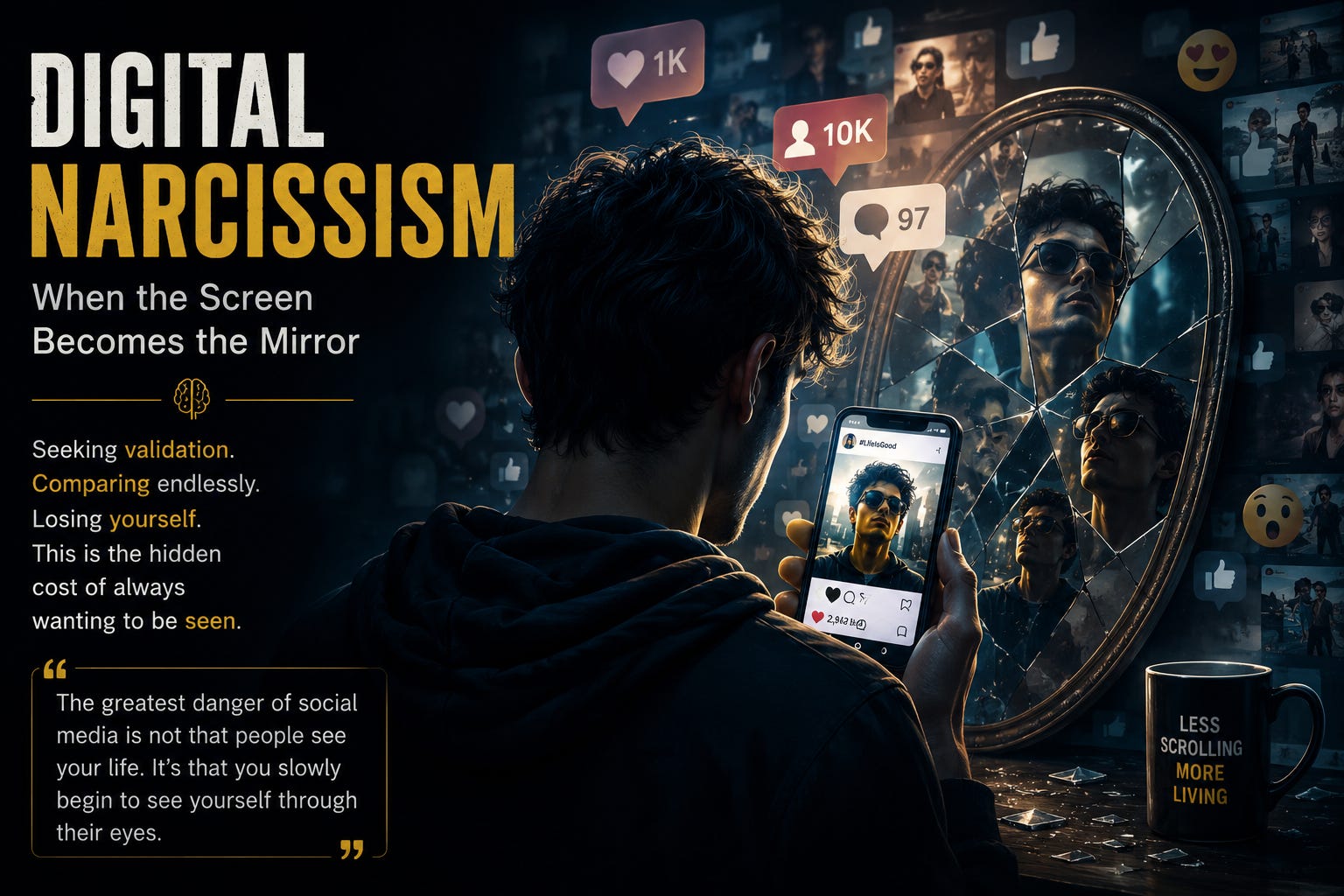
“The greatest danger of social media is not that people see your life. It’s that you slowly begin to see yourself through their eyes.”
We Didn’t Become More Narcissistic Overnight
Have you ever deleted a photo because it didn’t get enough likes?
Checked who viewed your story before replying to an important message?
Felt disappointed after sharing something meaningful because almost nobody reacted?
Or found yourself comparing your ordinary Tuesday to someone else’s highlight reel?
If you answered yes to any of these, you’re not alone.
Modern technology has quietly changed one of the oldest psychological needs humans have: the need to be seen.
The problem isn’t social media itself. The problem is what happens when our sense of identity becomes dependent on constant digital validation.
Psychologists increasingly refer to this pattern as digital narcissism. It doesn’t mean everyone is a narcissist. Instead, it describes how digital environments encourage narcissistic behaviors, even in emotionally healthy people.
The screen becomes a mirror. Every notification becomes a small judgment about our worth.
And most people never notice it’s happening.
Narcissistic Personality Disorder
The Human Brain Was Never Designed for This
For thousands of years, humans lived in small communities.
Recognition came from family.
Respect came from contribution.
Status developed slowly.
Today, a single post can be judged by thousands of strangers in minutes.
Every like...
Every follower...
Every share...
Every comment...
becomes psychological feedback.
Our brains treat these tiny digital signals as social approval, releasing dopamine that encourages us to seek more.
The cycle feels harmless.
Until our self-worth begins depending on it.
Validation Slowly Replaces Identity
One of the most disturbing changes happens quietly.
People stop asking,
“Who am I?”
and start asking,
“How am I being perceived?”
These are completely different questions.
Identity comes from values.
Validation comes from other people.
When validation replaces identity, people begin changing themselves to match what receives attention.
Opinions become performances.
Kindness becomes content.
Experiences become opportunities to post.
Life slowly transforms into personal branding.
The New Currency Is Attention
Attention has become one of the most valuable resources on Earth.
Companies compete for it.
Algorithms optimize for it.
Creators monetize it.
Influencers build careers around it.
But psychologically, attention behaves differently from money.
The more attention people receive, the more attention they often crave.
Research on reward systems consistently shows that unpredictable rewards are especially addictive. Social media platforms naturally create this pattern because every post performs differently. Sometimes it receives enormous engagement. Sometimes almost none.
That uncertainty keeps people checking again and again.
The Performance Never Ends
One overlooked consequence of digital narcissism is emotional exhaustion.
When every interaction feels public...
Every vacation becomes content.
Every meal becomes a photo.
Every achievement becomes an announcement.
People stop fully experiencing their own lives.
Instead of asking,
“Did I enjoy this?”
they unconsciously ask,
“Will other people enjoy seeing this?”
Psychology calls this self-monitoring.
High self-monitoring isn’t always unhealthy.
But when it becomes constant, authenticity begins disappearing.
Why Comparison Is Winning
Human beings naturally compare themselves with others.
Psychologists call this social comparison.
Before the internet, comparison happened with neighbors, classmates, or coworkers.
Today we compare ourselves with celebrities...
Entrepreneurs...
Fitness models...
Travel influencers...
Millionaires...
People using filters...
People editing their successes...
People hiding their failures.
Our brains rarely remember that we’re comparing our ordinary reality with someone else’s carefully selected moments.
No wonder so many people feel inadequate.
Digital Narcissism Doesn’t Always Look Like Arrogance
Many people imagine narcissism as loud confidence.
Psychologically, it often looks very different.
It can appear as:
Constantly checking notifications.
Feeling anxious after posting.
Measuring success through engagement.
Deleting posts that “underperform.”
Needing online approval before feeling good.
Obsessing over personal image.
Becoming emotionally affected by strangers’ opinions.
Feeling invisible without posting regularly.
These behaviors are becoming increasingly common.
Not because everyone has a personality disorder.
Because the digital environment rewards them.
The Algorithm Doesn’t Care About Your Well-Being
Algorithms are not psychologists.
They are engagement machines.
Content that triggers outrage...
Envy...
Fear...
Curiosity...
or emotional intensity...
often receives more visibility.
Over time, creators naturally learn which version of themselves earns the most attention.
Many gradually become exaggerated versions of who they once were.
The internet doesn’t always reward authenticity.
It often rewards intensity.
The Hidden Cost
Digital narcissism steals things people rarely notice.
It steals presence.
It steals genuine conversations.
It steals quiet confidence.
It steals intrinsic motivation.
It steals the ability to enjoy moments that nobody else sees.
Perhaps its greatest cost is this:
People become experts at managing impressions while slowly losing touch with themselves.
How to Protect Your Mind
Digital platforms are unlikely to become less persuasive.
But you can become more psychologically aware.
Ask yourself these questions regularly:
Would I still do this if nobody could see it?
Am I sharing because I value this, or because I want approval?
Does this platform make me feel inspired or inadequate?
When was the last time I enjoyed an experience without documenting it?
Who am I when the phone is turned off?
The answers matter more than your follower count.
☕ One Coffee. Thousands of Minds.
Every contribution helps turn complex psychology into free, practical knowledge that reaches readers around the world.
If this article was worth your time, consider buying me a coffee.
Hello! Thank you for your fascinating article and Psychological Challenge.
Please, allow me to contribute to it from a different angle.
Your article brilliantly explains how social media monetizes our need for Validation. I would add one deeper layer from Thought Management Science™:
“The real scarcity of the 21st century is not information—it is Attention.”
Attention is the gateway through which Consciousness exercises Authority over the Human Mind. Wherever our Attention goes, our thoughts, decisions, and ultimately our lives begin to follow.
When that Attention is continuously captured by notifications, algorithms, likes, and endless scrolling, we gradually surrender the very faculty that allows us to choose Consciously. As Thought Management Science™ argues, divided Attention weakens Causation, while focused Attention strengthens intentional action and the creation of meaningful outcomes.
Perhaps Digital Narcissism is not simply an obsession with being admired. Perhaps it is the consequence of allowing external platforms to decide where our Attention belongs. We stop directing our minds and begin renting them out, one notification at a time.
The most valuable question today may no longer be,"How many people are paying Attention to me?" but rather, "Who—or what—is controlling my Attention?"
Because the moment we lose Authority over our Attention, we slowly lose Authority over our Identity.
And when Consciousness no longer directs Attention intentionally, the external environment inevitably does. In an economy built on capturing Attention, protecting it may become one of the highest forms of Psychological Freedom.
--------------------------------------------------------------------------------
Education and Training in Thought Management Science™ and its Technologiesare available at the Institute of Thought Management.
Kindest regards,
Prof. Dr. Michael Puzzolante
Founder & Chairman of the Institute of Thought Management
Developer of Thought Management Science™
this hit different. so much of my own journey has been learning to root my identity in something deeper than likes and views. needed this.