

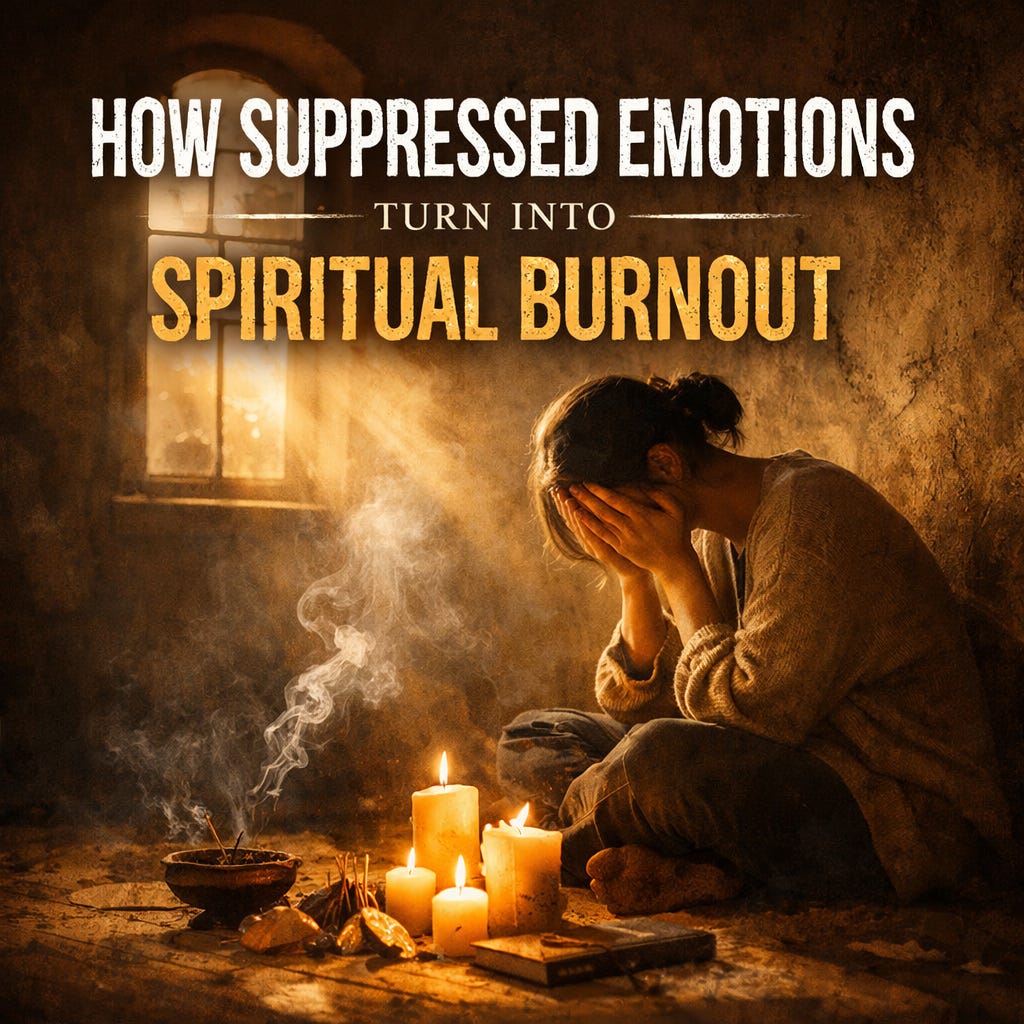
“Your soul does not break from pain. It breaks from holding pain in silence.”
There is a form of exhaustion that cannot be corrected with sleep, productivity tools, or better time management.
It is not physical depletion.
It is not simple mental fatigue.
It is spiritual burnout.
In spiritual psychology, burnout is rarely the result of doing too much. More often, it emerges from carrying unprocessed emotional weight while attempting to maintain a spiritually composed identity.
When emotions are suppressed in the name of maturity, positivity, or transcendence, the psyche begins to fragment. Over time, this fragmentation drains vitality, clarity, and meaning.
The Psychological Cost of Emotional Suppression
From early development, many individuals internalize messages about which emotions are acceptable.
Anger becomes inappropriate.
Sadness becomes weakness.
Fear becomes incompetence.
Grief becomes something to “move on” from quickly.
To adapt, the personality learns regulation strategies that appear functional. Individuals become composed, reflective, even spiritually articulate. However, suppression is not regulation.
In spiritual psychology, emotional suppression is understood as a defense mechanism. It protects the ego from discomfort but prevents integration of emotional experience.
When emotions are not processed, they do not disappear. They become somatic. They lodge in the nervous system. They influence perception, behavior, and spiritual experience.
Over time, this creates a quiet internal tension between the performed self and the felt self.
That tension is the beginning of burnout.
Spiritual Bypassing and Identity Fatigue
A common phenomenon in spiritual communities is spiritual bypassing. This occurs when spiritual concepts are used to avoid psychological work.
Pain is reframed too quickly as a lesson.
Anger is dismissed as ego.
Grief is intellectualized as growth.
Fear is denied in favor of faith language.
While spiritual framing can be meaningful, premature transcendence prevents emotional digestion.
The nervous system cannot be bypassed through insight alone. Emotional energy must move through awareness, expression, and integration.
When individuals consistently override emotional truth in order to maintain a spiritual identity, they create identity fatigue. The inner world feels unseen by the outer persona.
Meditation becomes mechanical.
Prayer becomes performative.
Gratitude becomes forced.
This is not a failure of spirituality. It is a misalignment between emotional reality and spiritual self-concept.
The Body as the Archive of Suppressed Emotion
Trauma research and somatic psychology demonstrate that the body stores unresolved emotional experience.
Chronic muscle tension may reflect suppressed anger.
Shallow breathing may signal unprocessed fear.
Persistent fatigue may indicate unresolved grief.
Spiritual burnout often presents as:
Loss of inspiration
Emotional numbness
Disconnection from meaning
Cynicism toward previously nourishing practices
Unexplained exhaustion
These symptoms are frequently interpreted as spiritual weakness. In reality, they are signals of emotional backlog.
Every suppressed emotion requires psychological energy to contain. That energy is diverted from creativity, intimacy, intuition, and purpose.
Over time, vitality diminishes.
Emotional Integration as Spiritual Maturity
Spiritual growth does not require emotional transcendence. It requires emotional integration.
Emotional avoidance states: I should not feel this.
Spiritual maturity states: I can feel this and remain whole.
Suppression fragments the self. Integration unifies it.
When anger is acknowledged without judgment, it becomes clarity.
When grief is honored, it becomes depth.
When fear is faced, it becomes discernment.
Spiritual psychology emphasizes wholeness rather than perfection. Wholeness includes shadow material, contradictory emotions, and uncomfortable truths.
Burnout arises when the psyche expends excessive energy maintaining an image that excludes these dimensions.
The Energetic Drain of Suppression
Life force, or psychological vitality, is finite. When large portions of it are allocated to suppressing emotion, there is less available for conscious living.
This can manifest as:
Reduced motivation
Emotional detachment in relationships
Loss of creative impulse
Difficulty accessing intuition
Spiritual dryness
The individual may attempt to compensate with more discipline, more practices, or stricter routines. However, burnout rooted in suppression cannot be resolved through effort alone.
It requires emotional permission.
The Path Out of Spiritual Burnout
Healing spiritual burnout begins with restoring emotional honesty.
This includes:
Naming feelings without spiritual reframing
Allowing grief without rushing to meaning
Acknowledging anger without moralizing it
Admitting exhaustion without shame
Emotions are not obstacles to spirituality. They are access points to deeper integration.
When emotional energy is processed rather than contained, vitality gradually returns. Spiritual practices regain authenticity because they are no longer compensating for avoidance.
The individual shifts from performing spirituality to embodying it.
If this writing supported your inner journey in any way, you can support me by buying me a coffee. Your support directly helps me continue creating content that speaks to emotional truth and spiritual growth.
This spoke to me on many levels, i recognise myself in your words and I've been experiencing this in varying levels over the last years, thank you
Self-Acceptance as described in this post is also an essential pillar of healthy self-esteem.