
Human Psychology : The Face That Stopped Answering

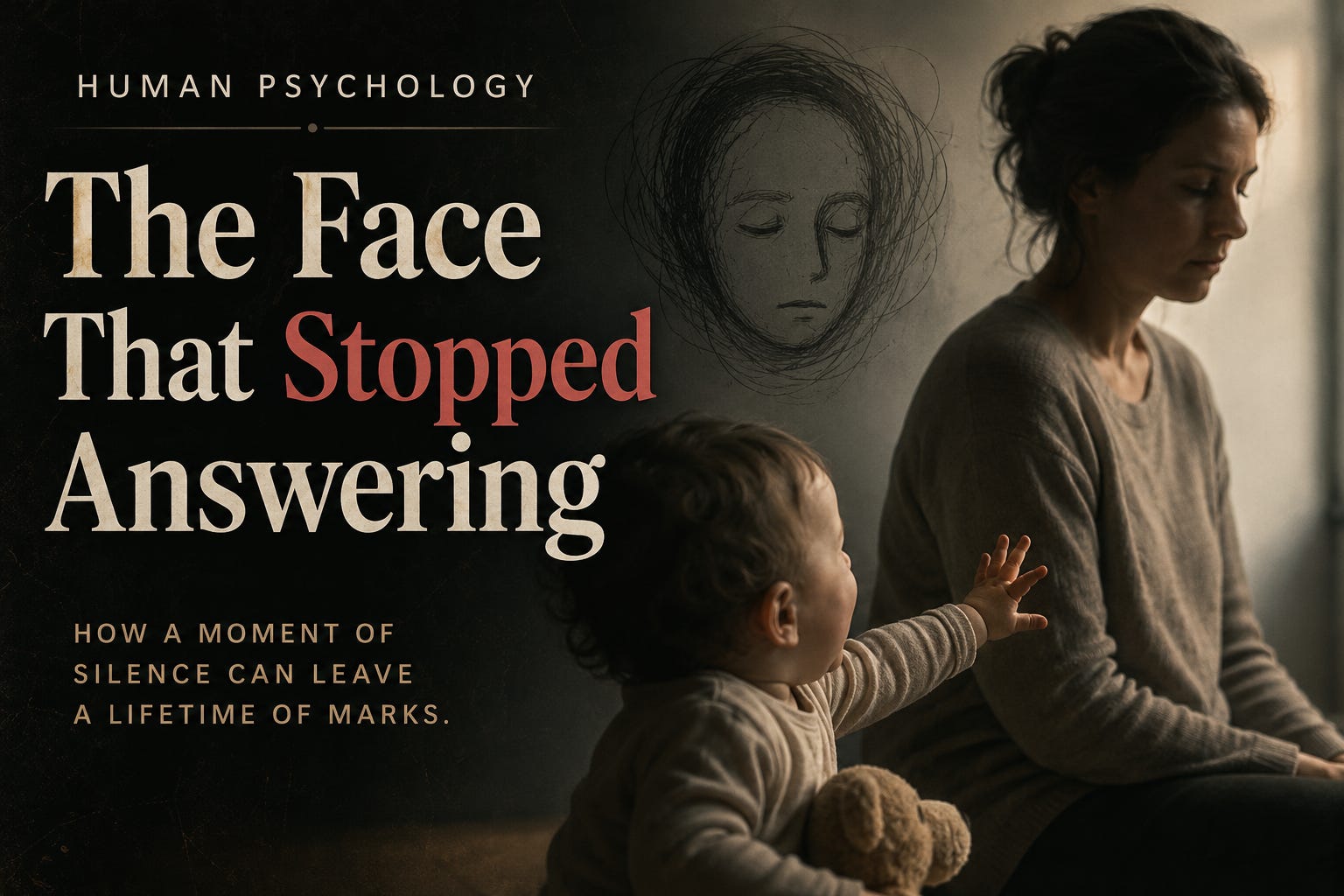
A mother sits with her baby.
They are fine. They are playing. The baby’s whole body is in it, the way only a small child can be in something: leaning forward, bright, offering a sound, waiting for the sound to come back.
Then the mother stops.
She does not leave the room. She does not raise her voice. She does not even frown. She just lets her face go still, as if someone turned the lights off behind her eyes.
The baby tries to bring her back.
A smile. A reach. A little performance. The kind of trying that would be funny if it were not so serious. When none of it works, the baby looks away, then back, then away again. The body folds. The sound that comes out is not a request anymore. It is a collapse.
This is not a metaphor. It is an experiment. A psychologist named Edward Tronick ran it in the 1970s, and people who watch the film still go quiet in the same place.
If you have ever talked to someone who was in the chair and not in their face, you already know the rest. You have been that baby. You have, on some days, been that mother. The mind will argue about this. The body will not.
The need is that old
We like to pretend that adult pain is adult.
That heartbreak is a story about romance. That a delayed message is a logistics problem. That a partner staring at a phone while you speak is only rudeness. That a parent who fed you and clothed you and drove you everywhere could not possibly have left a hole, because they were there.
The still face says otherwise.
The need to be answered is older than language. Older than your personality. Older than the speech you give yourself about being too sensitive. A baby cannot think, they are tired, they had a long day, this is not about me. A baby only knows: the face that makes me real has gone out.
So the alarm is not poetic. It is early.
When someone you love goes blank, your body does not file it under “busy.” It files it under disappearance. That is why a silent room can feel like dying even when nothing dramatic has happened. No door slammed. No cruel sentence. Just a face that stopped answering.
You will look crazy to anyone who only counts the facts. The facts say: they are right here. Your chest says: they are gone.
Both can be true. That is the whole wound.
A self is something that happens between two faces
A baby does not start out knowing who it is.
It finds out by looking. The mother’s face is the first mirror. When the baby offers a feeling, and the face offers it back, something like a self can land. I am here. I happen. The world answers.
When the mirror goes still, there is nowhere for the feeling to go. It hangs in the air and then falls. For a moment the baby is not a person in a relationship. The baby is a sound in an empty hall.
This is why being unseen does not feel like a small insult. It feels like a brief erasure.
Grown people spend fortunes trying to describe this and land on smaller words: ignored, dismissed, not prioritized. Those words are polite. They keep the evening usable. What you actually felt was closer to: I reached, and the world did not confirm that I exist.
Philosophy has chased this for a long time, in heavier language. You do not need the heavier language. You have lived it. You live it when you tell a story and watch their eyes slide to a screen. You live it when you cry and they wait for you to finish as if you were weather. You live it when you walk into a room and the face you wanted does not change.
Love is not only what people do for you. Love is whether their face still participates in yours.
The childhood that looks like nothing
Some still faces are loud. A slammed door. A house that taught you to read footsteps.
Most are not.
Most look, from the outside, like a decent life. Food on the table. School paid for. No obvious villain. A parent who was tired, or depressed, or from a people who did not do faces, or so overloaded that the lights behind the eyes went out at 6 p.m. and did not come back until morning.
They were there.
And they were not.
You learned to perform. Funny. Useful. Easy. Quiet. The child who does not add weather to a house already under weather. You got very good at reading tiny shifts: the mouth, the shoulders, the moment the warmth left the room without anyone standing up.
People will tell you that you are lucky. They are not entirely wrong. Luck and hunger can share a childhood.
The hunger stays in a strange form. You can be praised and still feel unpaid. You can sit in a full kitchen and feel the old blankness. You can love your parent and still flinch when a face goes still, because the body does not do courtroom evidence. The body does recognition.
If this is you, you may spend years choosing people who feel like home, and then wonder why home feels like waiting.
It feels like waiting because waiting is what you practiced.
Love, after the eyes leave
Then there is the other room.
Someone used to turn toward you. Not as a favor. As a reflex. You walked in and their face did a small bright thing, the way a room does when a lamp is switched on. You got used to that lamp. You built a life around the idea that it would keep doing that.
Then it didn’t.
They are still on the couch. They still say what? when you say their name. They still eat with you. They still use the word us. Only the face has changed. The lights behind the eyes are doing something else: a job, a grudge, a phone, a private weather they do not invite you into.
So you do what the baby did.
You try to bring them back.
You get more interesting. More useful. More sexual. More small. You tell the story better. You pick the fight you think will force a real expression, because even anger is a face. Anger still answers. Blankness does not.
This is the part people mock from a distance. Why didn’t you just leave. Why did you send the second message. Why did you explain yourself to a person who was not looking.
They mock it because they are not in the experiment. In the experiment, the baby does not leave. The baby tries. Then the baby folds. Then, if the face returns, the baby comes back too, messy, unsure, already a little older.
You were not weak. You were running the oldest program you have: restore the face, restore the world.
You were not addicted to them
Here is the cruel mechanic.
In the experiment there is a last stage. The mother comes back. She answers again. The baby, after a struggle, returns to her.
That return is not a small thing. It is relief so deep it teaches the body a lesson: do not go, the face comes back.
If the answering is steady, the lesson is safety.
If the answering is sometimes, the lesson is hunger.
A face that always answers becomes ordinary. A face that vanishes and then floods you with presence becomes fate. You will call it chemistry. You will call it a spark. You will call it this is the one, because the one is the person who can turn the lights back on in a room that went dark.
You were not addicted to them.
You were addicted to the return.
The almost. The moment their eyes finally find you again. The text after the silence. The apology after the blank week. The sudden warmth that makes the waiting feel like it was a price you were right to pay.
Slot machines use this. So do people who love you in pieces. So do you, on the days you disappear and then come back with gifts and intensity, and mistake the other person’s relief for proof that the disappearing was allowed.
The hook is not the love. The hook is the restoration of the face.
Once you see that, a calm person can feel boring, and a disappearing person can feel like destiny. That inversion has wrecked more lives than cruelty. Cruelty you can name. This one feels like hope.
The day your face is the one that stops
If the article only made other people the still face, it would be a lullaby. It would let you stay innocent.
You have gone blank too.
You were in the room. Someone was offering you their day, their hurt, their small bright try. And something in you left. Not because you did not care. Because you were flooded. Because you learned young that a still face is how a person survives a wave. Because you were on a screen. Because you had no more face left to give, and the body chose freeze the way it sometimes chooses freeze: as a closing of the shop, not as a verdict on the customer.
They looked at you the way the baby looked at the mother.
If you have any conscience at all, that memory is worse than the memories where you were the one begging. Being abandoned is a wound. Abandoning someone with your eyes while your body stays in the chair is a kind of horror that does not show up in photographs.
This is important, or the whole thing becomes a hunt for villains.
A still face is often not hatred. It is often a person drowning so quietly that they look like stone. Stonewalling, the cold shoulder, the empty stare in a fight: from outside it reads as indifference. Inside, the heart is frequently loud. The face closes because the person behind it cannot stay in the contact without coming apart.
That does not make it harmless. The baby does not care why the lights went out. The lover does not care that your silence was self-protection. The effect is the same. A why can be true and still leave a wreck.
You can understand your own blankness without using it as a permission slip. You can understand theirs without kneeling in front of it for the rest of your life.
What the silence is actually saying
A still face says several things at once, and the mind grabs the worst one.
It may be saying: I am overwhelmed.
It may be saying: I never learned how to stay when a feeling enters the room.
It may be saying: you have become furniture to me.
It may be saying: I am depressed and my face is telling the truth before my mouth can.
It may be saying nothing about you at all.
The tragedy is that the old alarm cannot tell these apart. To a nervous system trained on disappearance, all blankness is the same animal. So you escalate, or you vanish, or you start a fire just to get a weather report. Anything but the open air of unansweredness.
You do not need a ten-step plan for this. You need a more accurate sentence.
The accurate sentence is not they don’t love me. Sometimes they don’t. Sometimes they do, and their face has not caught up. The accurate sentence is closer to this:
My body treats an unanswered face as a threat, because that is how I was first built.
Once that is sayable, you get a little space. Not healing, not yet. Space. In that space you can ask a cleaner question than why are they doing this to me. You can ask: is this a person whose face comes back in a way I can live with, or am I back in the experiment, trying to restore a mirror that has decided to be a wall.
Those are different lives. They only feel the same at 1 a.m.
I write these so the blankness has a name. So you do not have to sit in that old room alone, calling yourself too sensitive, too much, too late.
If this one found your face, you can answer it.
One coffee is not a tip for a trick. It is a vote that this kind of writing should keep turning toward you next week. No course. No funnel. No one selling you a better personality.
Then keep reading. The last part is the part I almost did not write.
Stay in your own face
You cannot think a face back on.
You cannot be so good, so clear, so unarguable that someone is forced to meet you. The baby already tried the best version of that. It did not work. Performance is not contact. It is a petition.
What you can do is smaller, and harder.
You can notice the moment you start the old show. The extra joke. The extra explanation. The extra check of the phone. The sudden need to become a person they cannot look away from. That moment is the wound lighting up. It is not proof that you are pathetic. It is proof that something ancient in you still believes a face can be convinced.
You can notice the moment you go still. The jaw. The eyes that keep looking while you leave. If you can say, even late, I am not here, I am flooded, I need a minute, you have already done something the original experiment did not allow. You have let the other person know the lights are out on purpose, for now, and not because they have ceased to exist.
You can choose, once in a while, people whose faces do not make you earn the lamp. Steady will feel like less at first. That is not because steady is empty. It is because your hunger was trained on famine. A regular meal can taste like nothing when you are built for the almost.
And you can stop asking the old mirror to finish you.
There are faces that will not come back. A parent who is still alive and still blank. A lover who kept the apartment and left the look. A friend who became polite. You may wait anyway. People do. Waiting can become a personality.
Or you can, without a speech, take your face back to the room you are actually in.
The baby had no other room. You do.
That is not a triumph. It is a fact, and it is almost enough. You are not the infant in the film anymore, even when your chest is. You can be answered by a life that is here: work that holds your attention, a person who turns, a morning that does not require an audience, your own eyes in the glass, not as a judge, as a witness.
The still face taught you that love is the answering.
It also taught you, if you let it, the other half: you cannot spend the rest of your years as a petition to a door that has forgotten it is a door.
Let the experiment stay in the lab.
Stay in your own face.
Even if, for a while, it shakes.