

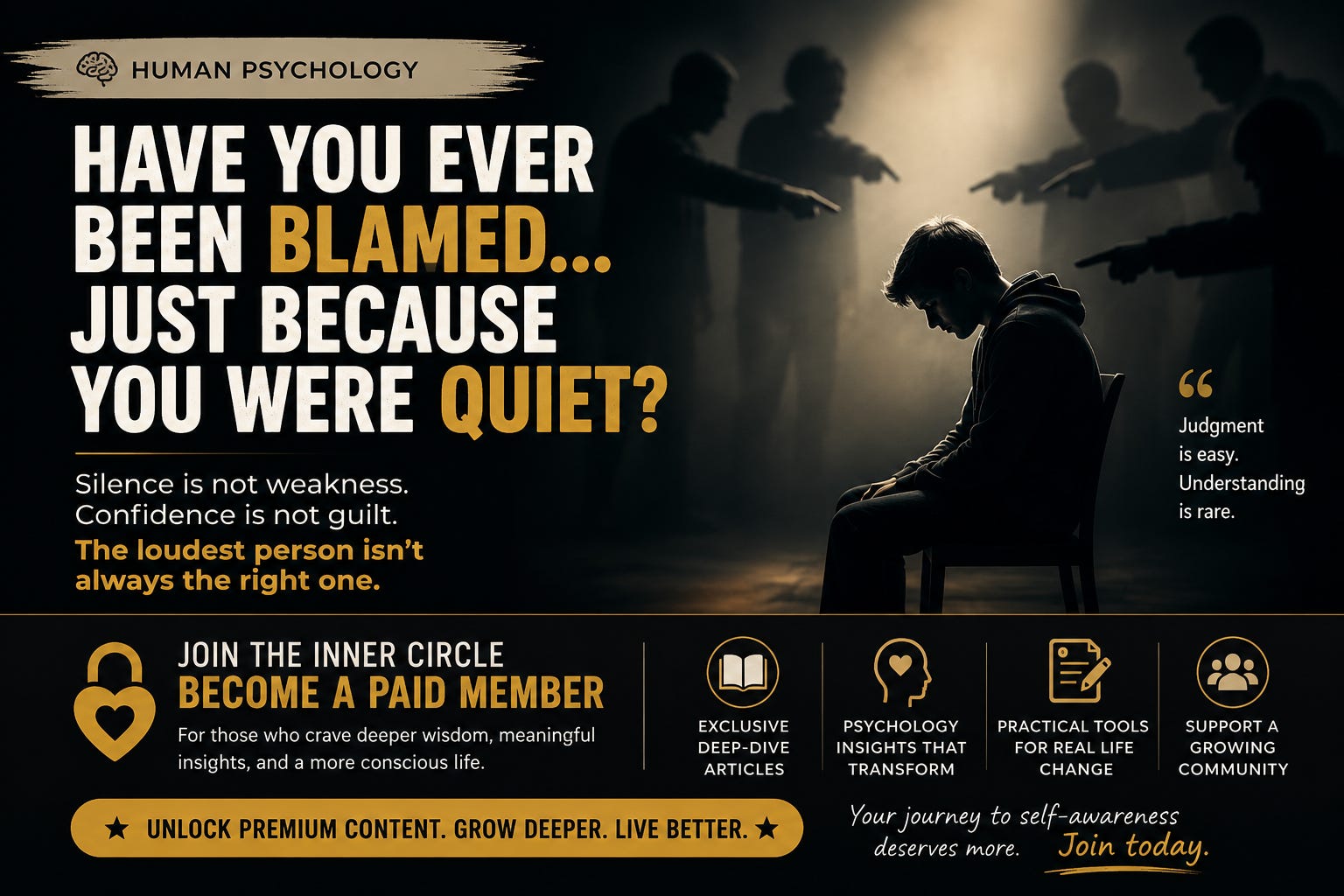
Some wounds never leave marks.
They leave questions.
“Why didn’t anyone believe me?”
For many people, one of the deepest emotional pains isn’t failure.
It isn’t rejection.
It’s being judged for something they never did.
Almost everyone has lived through a moment like this.
Something goes wrong.
The room falls silent.
Nobody knows the truth.
Yet somehow, the quietest person becomes the easiest person to blame.
Not because they’re guilty.
Because they’re quiet.
This reveals something uncomfortable about human psychology.
Our brains are wired to hate uncertainty. When we don’t have enough information, we don’t wait—we create it. We build stories from incomplete evidence and mistake those stories for reality.
Silence becomes suspicion.
Calmness becomes guilt.
And confidence becomes credibility.
The tragedy is that none of these assumptions are necessarily true.
Some people stay quiet because they were taught not to interrupt.
Some stay quiet because they’ve spent a lifetime believing their voice doesn’t matter.
Some stay quiet because they’re protecting their peace.
Yet the world often mistakes their silence for an admission of guilt.
Perhaps that’s why being falsely accused hurts so deeply.
It isn’t just about the accusation.
It’s the realization that people were willing to believe the worst about you before they were willing to understand you.
And when the truth finally appears...
Many move on.
Few apologize.
Because admitting a wrong judgment requires something our minds naturally resist:
Humility.
The next time you meet someone who speaks less than everyone else, remember this:
You are not looking at a lack of character.
You are looking at a story you haven’t heard yet.
Every quiet person is carrying a world that cannot be measured by the number of words they speak.
The deepest truths are rarely the loudest.
And one of the greatest acts of emotional intelligence is choosing to understand someone before deciding who they are.
Sometimes, the kindest thing you can do isn’t to speak first. It’s to ask before you assume.
❤️ Enjoyed This Insight?
If this article helped you understand human psychology a little better, consider buying me a coffee.
Every contribution helps me spend more time researching, writing, and sharing psychology that genuinely improves lives.
This is a reminder that we need to learn how to be silent sometimes.
This is a thoughtful reminder that quietness is often misunderstood. People can carry whole stories beneath silence.