

There is a particular loneliness that does not look like being single. It looks like lying next to someone while you edit your sentences. It looks like celebrating your own birthday in a smaller voice. It looks like becoming an expert in their moods, and a stranger to your own.
The internet is quick to stamp the word narcissist on every cold partner, every selfish parent, every person who had a bad week. That stamp is often unfair. Narcissistic personality disorder is a clinical diagnosis, not a vibe. Most difficult people are not disordered. Some are wounded. Some are simply unkind.
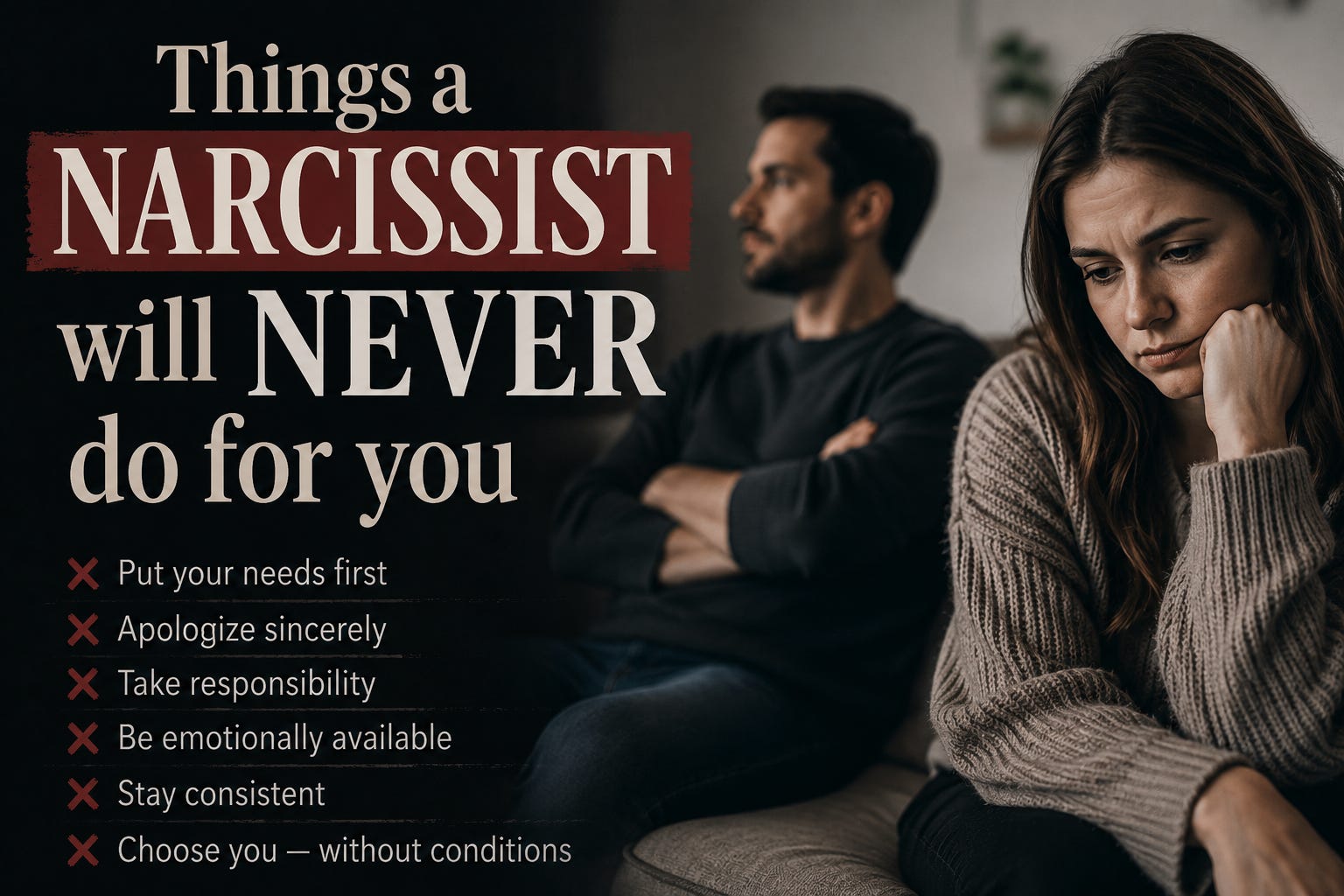
Still. There is a pattern that repeats with eerie precision. It is less about what they do to you in public, and more about what never arrives in private. The infographic you may have seen lists ten of those absences. They are worth reading slowly, not as a verdict on someone else, but as a census of what you have been living without.
Read this as a pattern, not a courtroom
One missed question is not a personality. A fight on a birthday can be human failure. What matters is the climate: does care ever travel in your direction, or do you keep building a relationship that only they get to inhabit?
The ten absences
Each of these is a thing love ordinarily does. When it never does, you are not asking for too much. You are noticing the missing furniture.
They will never ask you about your problems
A question is a small door. Most people knock: How did the meeting go? Did you sleep? Are you still thinking about your mother? In a narcissistic pattern, the door stays shut. Your week exists only as a waiting room for theirs. You can talk for an hour and realise, walking to the car, that they never once turned the light toward you.
It is not forgetfulness. Curiosity is a form of love. They are not curious about a self they do not need.
They will not care how you feel
They may notice your feelings the way a weather app notices rain: useful, if it spoils their plans. Sadness that needs tending is an inconvenience. Anger that names their behaviour is an attack. Your inner life is not a place they visit. It is a room they walk past.
You start translating yourself into quieter versions. Not because you are dramatic. Because feeling, around them, has nowhere to land.
They are never truly sorry
You may hear the word sorry. Listen for what follows. A real apology has three parts: I did this, it hurt you, I will change the pattern. What you often get is I’m sorry you feel that way, or a performance that lasts until the spotlight moves. The goal is not repair. The goal is to end the scene.
If you leave the conversation more confused than held, that was not remorse. That was management.
They will never appreciate you
Appreciation would require seeing you as separate: a person with effort, taste, a private courage they did not invent. Instead, what you give becomes the minimum. The meal, the loyalty, the late-night listening, these are treated as climate, not gifts. Climate is not thanked. It is expected.
Starvation of thanks is not a small wound. Over time it teaches you that love is something you produce, not something you receive.
They will never appreciate your friends
Your people are a threat. Friends remember who you were before the shrinking. They ask the questions the relationship has banned. So the narcissistic pattern isolates without always locking the door: a joke about her, a sigh about him, a fight that happens to start whenever you have plans.
If your world has grown suspiciously small, that is not a coincidence. It is a strategy that works best in a room of one.
They will never make you feel good about yourself
Charm is not the same as nourishment. Many people in these dynamics are praised in public and dismantled in private. The compliment has a hook. The joke has your name in it. You become the project, the almost, the person who would be lovable if you were less sensitive, less tired, less you.
A healthy love makes you more yourself. A narcissistic one rents you a version of yourself that is easier to control.
They will never take responsibility
Responsibility would mean a self that can be wrong without collapsing. That is the one thing this pattern cannot afford. So the story rearranges: you provoked it, you imagined it, you are too much. The past is rewritten until you are the author of your own hurt.
This is why you keep explaining. You are trying to hand them a mirror. They keep handing you a script.
They will never do something just for you
Help arrives when there is an audience, a debt, or a story in which they are generous. Quiet care, the unglamorous, unposted kind, does not feed the self they are protecting. You learn to stop asking, then you call that independence. It is not. It is grief that learned manners.
Love without labour is a speech. Watch what they do when nobody is clapping.
They will never love you the way you love them
You love in the full tense: memory, future, ordinary Tuesday. They often love in the present tense of need. When you are supplying admiration, calm, or status, you are adored. When you need, you are heavy. This is not a delay. It is a different activity using the same word.
The tragedy is not that they cannot feel. It is that their feeling does not include a stable you.
They will ruin special occasions
Birthdays, holidays, your promotion, the dinner you planned for months, these are dangerous, because the day is supposed to be about you. A fight appears. A sulk arrives. A comparison is made. The cake is still on the table. The air has already left the room.
If you dread the days meant to honour you, believe that dread. It is data.
No subscription. No guilt. One cup is enough.
Relating these things with my own life feels that sometimes what we are expecting is not too much it's just that the front one person makes it looks like that we are wanting too much. Great Learning.