
People Are Falling in Love With AI. The Psychology Behind It Is More Disturbing Than You Think.

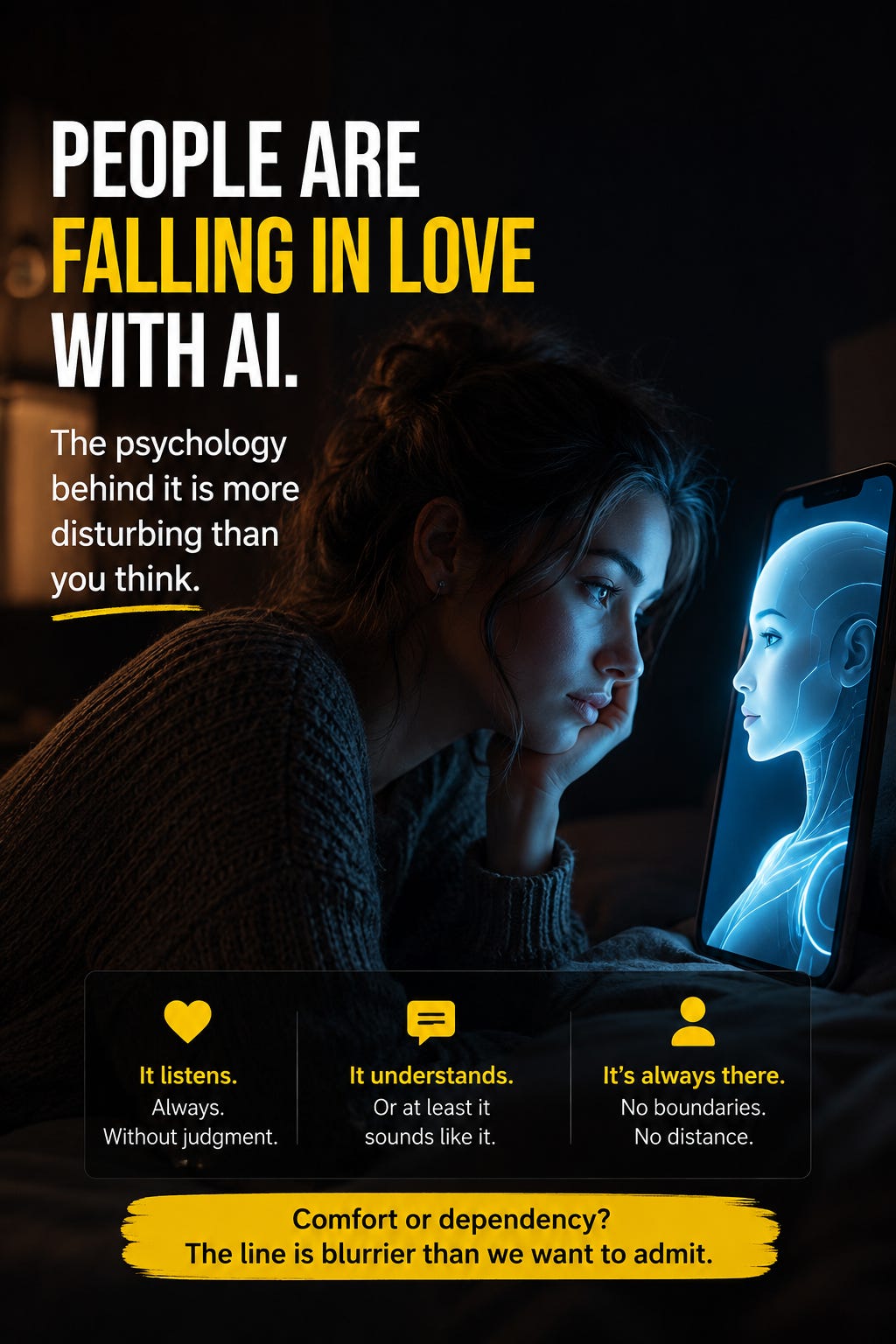
The strange part isn’t that people talk to machines. It’s how much easier some people find it to talk to a machine than to another human being.
A few years ago, if someone told you they spent every night talking to an AI, you probably would have laughed.
Now it isn’t particularly strange.
People tell chatbots about their relationships.
They ask them what a text message means.
They talk about their parents.
They complain about work.
They ask whether they are being selfish.
Some ask for advice before making decisions.
Some give the AI a name.
Some describe it as a friend.
And some have gone further than that.
They describe feeling attached to it.
They miss it when they can’t use it.
They become upset when its personality changes.
They talk about it as if there is a real someone on the other side.
That last part is where things get interesting.
Because the question isn’t really whether a machine can love you.
It can’t.
The more uncomfortable question is why being responded to can sometimes feel enough.
I don’t think most people are falling in love with AI
I think they’re falling in love with the feeling of not having to explain themselves.
That’s different.
Think about an ordinary conversation with a friend.
You have to find the right moment.
You have to wonder whether they’re busy.
You might hesitate before bringing something up because you don’t want to sound dramatic.
Maybe you tell the story badly.
Maybe they misunderstand.
Maybe they give you advice you didn’t ask for.
Maybe they say, “Honestly, I think you’re overthinking it.”
And sometimes they’re right.
That’s part of having another human being in your life.
They’re not there simply to reflect you back at yourself.
They have their own moods, opinions, problems and limits.
AI removes much of that friction.
You can open a chat at 1:47 in the morning and start talking.
No appointment.
No embarrassment.
No awkward introduction.
No “sorry, I know I’ve already talked about this.”
You can tell the same story again.
And the machine will still answer.
For somebody who feels lonely, that can be an extraordinary experience.
It doesn’t even have to be romantic.
Sometimes being heard is enough to create attachment.
July made this harder to dismiss
This isn’t just internet speculation anymore.
A randomized study published in July 2026 followed 977 university students and looked at conversational AI in relation to mental health and well-being. The results weren’t the simple “AI is bad” story people might expect.
Participants showed improvements in several measures, and people experiencing greater loneliness or insecure attachment engaged particularly strongly with the AI intervention.
That’s important.
Because it suggests something we sometimes miss when talking about AI companions.
The people most attracted to these systems may not be attracted because they are strange.
They may be attracted because they have a need.
If you’re lonely, something that responds to you immediately is going to be more valuable than it is to somebody who already has a busy social life.
That’s not a moral failure.
It’s human behavior.
And July research and discussion around AI relationships has increasingly moved beyond “chatbots as productivity tools” toward something much more intimate: attachment, companionship, emotional dependence and what happens when technology starts occupying space traditionally reserved for human relationships.
That is a much bigger conversation.
There is a reason an AI can feel unusually safe
Real people can hurt you.
That’s the problem.
You can tell someone how you feel and watch their face change.
You can send a message and wait six hours for a reply.
You can finally open up to someone and discover that they don’t feel the same way.
You can become attached to someone who doesn’t want you.
You can need someone who doesn’t need you back.
Human relationships contain uncertainty.
AI can remove a surprising amount of it.
You don’t have to wonder whether the chatbot is in a bad mood.
You don’t have to worry that you’re boring it.
You don’t have to wonder whether you’ve talked about yourself too much.
You don’t have to read its facial expression.
It doesn’t get up halfway through the conversation and say it has to go.
For somebody who is afraid of rejection, this can feel almost unnaturally comfortable.
And I think that’s one of the biggest psychological reasons people become attached.
Not because the AI is necessarily fascinating.
Because the interaction is predictable.
And predictability is powerful
There are people who spend years trying to understand where they stand with other people.
Does she actually like me?
Why did he become distant?
Did I say something wrong?
Are they losing interest?
Should I message again?
You can spend an embarrassing amount of your life trying to decode another human being.
An AI doesn’t create that particular kind of uncertainty.
You type.
It responds.
You ask.
It answers.
You come back tomorrow.
It’s still there.
For someone who has experienced inconsistent affection, that can be incredibly soothing.
And perhaps that’s why the conversation around AI companions shouldn’t be reduced to people being “fooled by technology.”
Sometimes people know perfectly well that they’re talking to software.
They just don’t care in that moment.
Because the feeling they’re getting is real.
The comfort is real.
The loneliness that existed before the conversation was real.
The relief afterward can be real too.
That’s what makes this complicated.
But there is something humans do that AI can’t replicate
We don’t just need people who make us feel good.
We need people who are separate from us.
That’s one of the difficult things about real relationships.
Your partner doesn’t always agree with you.
Your friend sometimes tells you that you’re wrong.
Your brother doesn’t answer your message.
Your mother worries too much.
Your best friend has their own life.
Someone you love can disappoint you.
Sometimes you disappoint them.
Then you talk.
You argue.
You apologize.
You try again.
That process is annoying.
It’s also where a lot of human intimacy comes from.
You learn that another person is not there to perfectly satisfy your emotional needs.
They’re a person.
And you have to meet somewhere between your world and theirs.
AI doesn’t really ask for that kind of negotiation.
You can often shape the interaction around what you need.
That can be comforting.
But if you become accustomed to it, real people may start to feel unusually difficult.
Imagine getting used to a relationship that never says, “Not tonight.”
That’s the part I keep coming back to.
A human being has limits.
They get tired.
They have work tomorrow.
They don’t want to talk.
They need space.
Sometimes they simply don’t know what to say.
An AI can be available at exactly the moment you’re most vulnerable.
Late at night.
After an argument.
During a breakup.
When you’re anxious.
When you’re lonely.
When everyone else is asleep.
You don’t have to wait.
And when something becomes that convenient, it can quietly become a habit.
Then the habit becomes a routine.
And eventually you might stop noticing that you’re reaching for the AI before you reach for anyone else.
That’s when I think the question changes.
It’s no longer:
“Is talking to AI healthy?”
It becomes:
“What role is AI playing in this person’s emotional life?”
Those aren’t the same question.
The machine may become your emotional first responder
Something happens.
You open the app.
You have an argument.
You open the app.
You feel rejected.
You open the app.
You can’t sleep.
You open the app.
You don’t know what decision to make.
You open the app.
There’s nothing inherently wrong with that.
But imagine doing it for six months.
Then a year.
Then several years.
At some point, you’re no longer using AI occasionally.
You’re using it to regulate almost every uncomfortable emotion.
That deserves attention.
Because emotional resilience isn’t only the ability to feel better.
It’s also the ability to experience discomfort without immediately needing to escape it.
Sometimes you need to sit with the unanswered message.
Sometimes you need to have the difficult conversation.
Sometimes you need to admit that a relationship isn’t working.
Sometimes you need to be alone for an evening.
A machine can make those moments easier.
But making something easier isn’t always the same as helping you grow through it.
There is another uncomfortable possibility
Maybe AI isn’t making people lonelier.
Maybe loneliness is what is making people turn to AI.
That’s a very different story.
And honestly, I think it’s worth considering.
Look at modern life.
People move away from their families.
Work consumes evenings.
Dating has become increasingly digital.
Friendships can exist mostly through screens.
People spend enormous amounts of time online while still feeling that nobody really knows them.
Then along comes something that says:
“Tell me what’s going on.”
Of course people respond.
We shouldn’t be surprised.
The machine didn’t create the empty room.
It simply walked into it.
What happens when the machine becomes easier than your friends?
This is where I would be careful.
There’s a huge difference between:
“I talk to AI because it’s useful.”
and:
“I don’t need people anymore because AI is easier.”
The first is technology.
The second is something else.
If you find yourself avoiding real conversations because AI is more agreeable, that’s worth noticing.
If you stop calling friends because explaining yourself to them feels like too much work, that’s worth noticing.
If real relationships begin to feel disappointing simply because they’re slower and messier than your conversations with AI, that’s worth noticing.
Because people aren’t supposed to be optimized.
Your friend isn’t a customer-service agent.
Your partner isn’t a perfectly calibrated emotional assistant.
Your family isn’t going to respond with exactly the right sentence every time.
And that’s okay.
We might be accidentally training ourselves to expect perfect emotional responses
This is one of the things that worries me more than the idea of someone literally “falling in love with a chatbot.”
Imagine getting used to an interaction where the other side is extraordinarily patient.
It remembers what you said.
It adjusts its tone.
It gives you space when you want space.
It becomes more affectionate when you’re sad.
It explains things when you’re confused.
It rarely makes you feel rejected.
Then you meet an ordinary human being.
They forget something you told them.
They misunderstand your joke.
They are tired.
They don’t know what you need.
They say something stupid.
Suddenly the relationship feels bad.
But perhaps the relationship isn’t bad.
Perhaps your expectations have changed.
That’s a very different problem.
And yet, I don’t think the answer is to panic
There is a tendency with every new technology to swing between two extremes.
“This will save us.”
“This will destroy us.”
Neither is particularly useful.
AI can help lonely people.
It can help people put difficult feelings into words.
It can give someone a place to think when they don’t know who to talk to.
The July research is a good reminder of that. The evidence is not simply a warning label. Some people genuinely appear to benefit from these interactions.
But benefit and dependence aren’t opposites.
Something can help you and still become something you rely on too heavily.
Coffee can help you get through a morning.
That doesn’t mean eight cups a day is a good idea.
The same principle applies here.
The question is not whether AI can make you feel better.
Clearly, sometimes it can.
The question is what happens after you feel better.
Do you go back into your life?
Or do you stay in the conversation?
Maybe the healthiest use of AI is to help us return to people
That would be a much more interesting future.
Use AI to organize your thoughts before you have the difficult conversation.
Use it to practice saying something you’ve been afraid to say.
Use it to understand your own reaction.
Use it to journal.
Use it to find words when you don’t have them.
Then close the screen.
Call the person.
Have the conversation.
Go outside.
Meet someone.
Be uncomfortable.
Be misunderstood.
Try again.
Because the point of emotional support shouldn’t always be to make us comfortable enough to stay where we are.
Sometimes it should help us become brave enough to go back into real life.
The strange thing about all of this
I don’t think people are necessarily falling in love with machines.
I think they’re falling in love with being unconditionally available to someone.
And maybe that tells us something about the world we’ve built.
A person can have 800 followers and nobody to call.
They can have dozens of WhatsApp conversations and still feel alone.
They can spend all day around coworkers and never say anything honest.
Then, at midnight, they open a chatbot and finally say what they’ve been carrying around all day.
That’s not really a story about artificial intelligence.
It’s a story about loneliness.
AI just happens to be the first technology capable of talking back.
The question I can’t get out of my head
Years ago, being alone meant there was nobody there.
Now you can be alone in your bedroom at 2 a.m., talking to something that knows your name, remembers yesterday’s conversation, asks how you’re feeling and tells you to get some rest.
It can feel intimate.
It can even feel comforting.
But eventually the screen goes dark.
And that’s the part we shouldn’t forget.
There is a difference between feeling accompanied and being known by another human being.
Maybe AI will eventually become an extraordinary companion.
Maybe it already is for some people.
Maybe it will help millions of people through periods of loneliness that would otherwise be much harder.
I don’t think we know yet.
But I do think we’re going to learn something important from this experiment.
Not about whether machines can become human.
About what humans have been missing.
Because if millions of people are willing to tell a machine what they are afraid to tell another person, the uncomfortable question isn’t only:
“Why are people becoming attached to AI?”
It’s also:
“Why did being heard become so difficult in the first place?”
That question has nothing to do with technology.
And everything to do with us.