

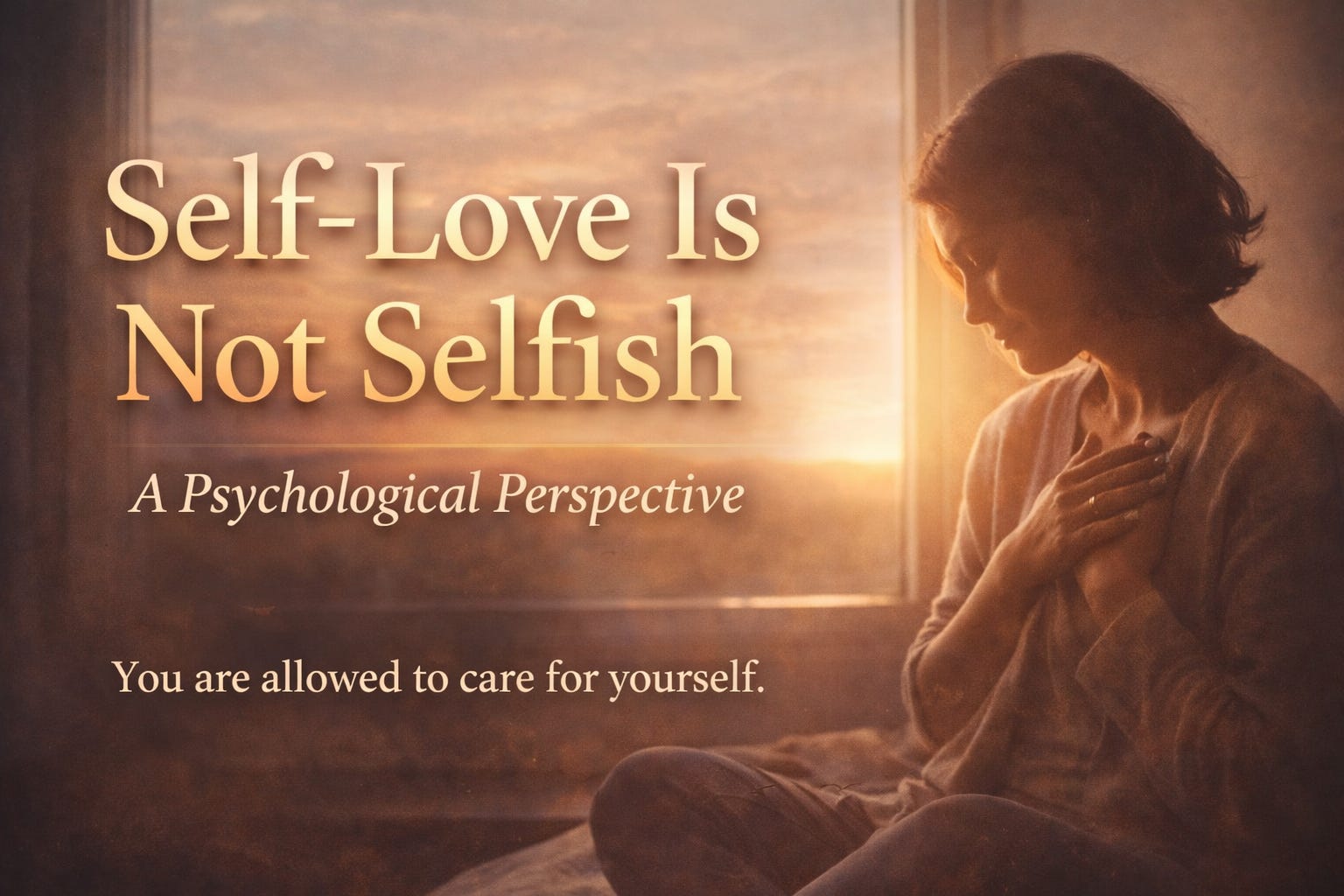
We grow up learning how to care for others.
We are taught to be polite, supportive, understanding, and giving.
But very few of us are taught how to care for ourselves.
Somewhere along the way, many people start believing that putting themselves first is wrong. That resting is lazy. That setting boundaries is rude. That choosing your own peace is selfish.
It isn’t.
Self-love is not selfish.
It is psychological survival.
And for many people, it is the missing piece in their healing.
Self-love is not choosing yourself over others.
It is choosing yourself so you can finally meet others without abandoning who you are.
Why Self-Love Feels So Uncomfortable at First
If you were praised mainly for being helpful, quiet, strong, or emotionally mature, you probably learned that your worth came from what you provided to others.
You learned to:
Put your needs last
Ignore your exhaustion
Minimize your feelings
Stay available even when you were empty
Over time, this creates a deep internal pattern:
I matter only when I’m useful.
So when you finally try to slow down, say no, or take care of yourself, guilt appears.
Not because you are doing something wrong, but because your nervous system was trained to survive through self-neglect.
Self-love feels unfamiliar before it feels safe.
The Psychology Behind Self-Love
Psychologically, self-love is not indulgence. It is regulation.
It means recognizing your emotional limits.
It means responding to your inner pain instead of abandoning it.
It means meeting your own needs instead of waiting for someone else to rescue you.
When you practice self-love, you are teaching your brain something powerful:
“I am allowed to exist without earning it.”
This changes how your nervous system responds to stress.
It changes how you attach to others.
It changes how much emotional weight you carry.
People who lack self-love often live in quiet burnout. They overgive, overthink, and overextend. They feel responsible for everyone’s feelings. They struggle to rest without guilt.
Self-love interrupts that cycle.
Self-Love Is Not Narcissism
There is a big difference between self-love and self-centeredness.
Self-centeredness says: Only my needs matter.
Self-love says: My needs matter too.
Healthy self-love actually increases empathy. When you are emotionally nourished, you stop seeking validation through sacrifice. You stop needing others to fill the emptiness inside you.
You become more present, not less.
You give from fullness instead of depletion.
The Paradox of Modernity: Where Values Are Lost in the Haze of Progress
A Second Chance at Life: The Inspiring Story of a Horse’s Redemption
From Tragedy to Triumph: Anmol Rodriguez’s Inspiring Journey
What Self-Love Looks Like in Real Life
Self-love is not always bubble baths and affirmations.
Sometimes it looks like:
Walking away from relationships that drain you
Resting even when you feel guilty
Saying no without explaining yourself
Feeling your emotions instead of suppressing them
Choosing peace over proving your worth
Eating, sleeping, and slowing down when your body asks
Stopping the habit of abandoning yourself for approval
It is quiet. It is subtle. It is often invisible to others.
But internally, it changes everything.
Why Self-Love Improves Your Relationships
When you don’t love yourself, you unconsciously ask others to do it for you.
You seek reassurance.
You tolerate poor treatment.
You stay where you are not valued.
You confuse attachment with connection.
Self-love gives you emotional independence.
You stop begging for breadcrumbs.
You stop chasing unavailable people.
You stop shrinking to keep others comfortable.
Not because you become cold, but because you finally feel whole.
The Hard Truth
You cannot heal in environments that require you to betray yourself.
You cannot grow while constantly minimizing your needs.
And you cannot truly love others while abandoning your own inner world.
Self-love is not about becoming perfect.
It is about becoming present with yourself.
Again and again.
Enjoy this post?
This really resonated with me. As someone still in the process of healing, I’ve come to realize that self-love isn’t something that comes naturally when you’ve learned to survive by putting yourself last. For a long time, I thought being strong meant ignoring my own needs and always showing up for others.
What you said about guilt really stood out to me. That feeling doesn’t come from doing something wrong, but from doing something unfamiliar. I’ve experienced how uncomfortable it can be to rest, set boundaries, or choose myself, even when I know it’s necessary.
But slowly, I’m learning that self-love is not about becoming selfish, it’s about no longer abandoning myself. As a survivor trying to turn my wounds into something that can bring light to others, this shift has been incredibly important. It’s changing not only how I treat myself, but also how I show up in my relationships.