

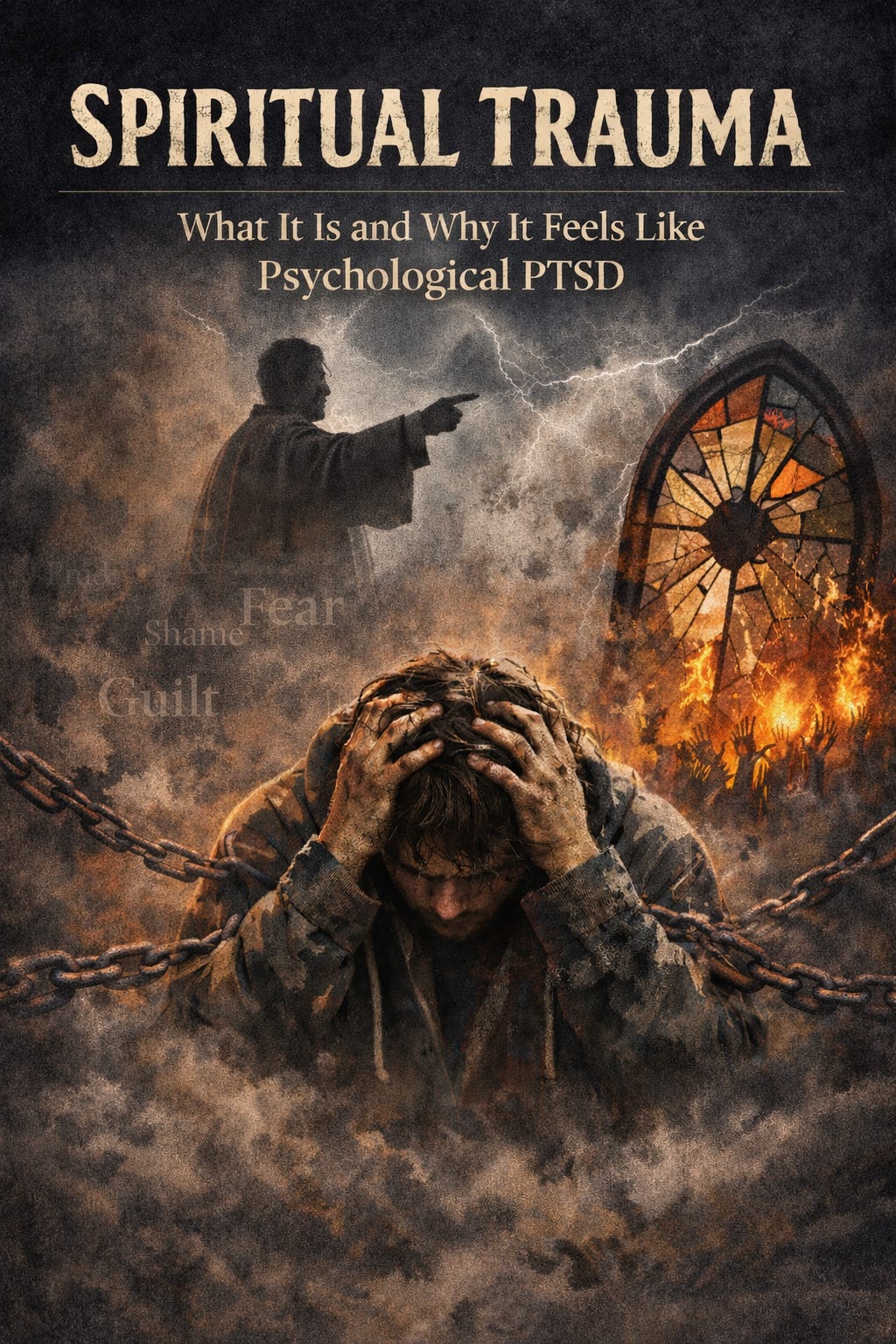
There is a kind of trauma that does not come from war, accidents, or visible violence.
It comes from belief.
It comes from being told that your questions are sinful.
That your doubt is dangerous.
That your pain is a punishment.
That your worth depends on obedience.
And when that kind of wound happens, it does not just hurt your faith.
It hurts your nervous system.
It hurts your identity.
It hurts your sense of safety in the world.
This is spiritual trauma.
And for many people, it feels almost identical to psychological PTSD.
What Is Spiritual Trauma?
Spiritual trauma happens when religious, spiritual, or ideological systems are used in ways that create fear, shame, control, or emotional harm.
It can look like:
• Being terrified of eternal punishment as a child
• Being shamed for natural emotions or sexuality
• Being silenced for asking honest questions
• Being manipulated through guilt in the name of God
• Losing your entire community after leaving a belief system
Spirituality is supposed to create meaning and connection.
But when it becomes a tool of control, the nervous system does not interpret it as “guidance.”
It interprets it as threat.
And the body remembers threat.
Why It Feels Like PTSD
PTSD is not only about physical danger.
It is about overwhelming fear and helplessness that the nervous system could not process at the time.
Spiritual trauma can create:
• Hypervigilance around moral mistakes
• Intrusive thoughts about punishment
• Panic triggered by religious symbols or language
• Nightmares about judgment or hell
• Deep shame that feels wired into identity
When someone says, “I left the religion years ago but I still feel afraid,” that is not weakness.
That is conditioning.
The brain learned that safety depended on compliance.
The amygdala learned that doubt equals danger.
And once fear is encoded deeply, logic alone cannot erase it.
The Hidden Psychological Impact
Spiritual trauma often damages three core psychological structures:
Attachment
If God was presented as loving but acted as threatening through authority figures, it creates disorganized attachment patterns. You may crave safety while expecting punishment.Identity
When your entire identity is built around a belief system, leaving it can feel like psychological death. You are not just changing opinions. You are losing your map of reality.Autonomy
If questioning was discouraged, your ability to trust your own thoughts may feel fractured. You second-guess yourself constantly.
This is why healing spiritual trauma is not about “just moving on.”
It is about rebuilding your internal sense of safety.
Signs You May Be Experiencing Spiritual Trauma
You might recognize this in yourself if:
• You feel intense anxiety when discussing religion
• You feel guilt for resting, enjoying life, or setting boundaries
• You fear being punished for small mistakes
• You struggle with black-and-white thinking
• You feel disconnected from your body or emotions
Many people mistake these symptoms for personal weakness.
They are not.
They are survival adaptations.
Healing Spiritual Trauma
Healing begins when fear is replaced with safety.
Not new beliefs.
Not forced positivity.
Safety.
This often includes:
• Nervous system regulation practices
• Trauma-informed therapy
• Relearning how to trust your own intuition
• Separating spirituality from control
• Allowing anger and grief to surface
The goal is not to destroy spirituality.
The goal is to rebuild it without fear.
Or to rebuild yourself without needing it at all.
A Truth That Matters
Spiritual trauma is painful because it attacks the deepest layer of human experience: meaning.
When meaning becomes weaponized, the mind does not know where to stand.
But here is the quiet truth:
You are not broken for questioning.
You are not weak for leaving.
You are not sinful for protecting your peace.
The body reacts to perceived threat the same way whether it comes from a battlefield or a belief system.
And your healing is valid.
If this piece held your heart gently, consider holding ours in return.
Your support keeps Spiritual Psychology alive, breathing, and reaching the souls who need it most.
Every coffee is not just a donation. It is a quiet “keep going.”
Totally 👍🏻