
The Dangerous Psychology of Control: The More You Need It, the Faster It Slips Away

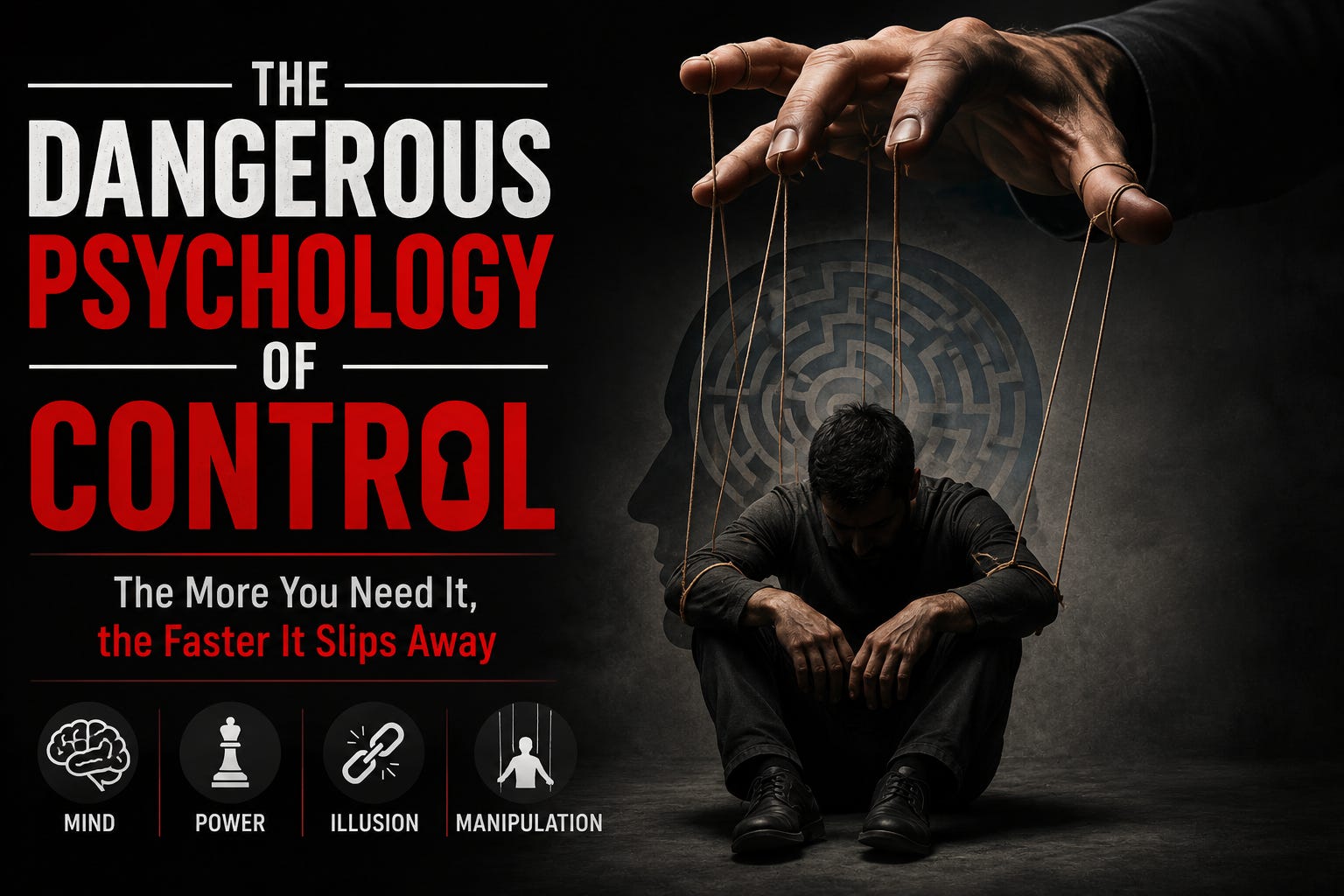
"Control feels like strength in the beginning. Eventually, it becomes the reason you can't rest."
There is a strange contradiction in human nature.
The more desperately a person tries to control life, the less peaceful that life usually becomes.
It doesn’t happen overnight. It happens quietly.
At first, it looks responsible.
You plan everything.
You prepare for every possibility.
You check every detail.
You don’t like surprises.
People even compliment you for being organized.
But somewhere along the way, responsibility can turn into something else.
You stop trying to manage your own life and start trying to manage everyone else’s.
You want people to respond the way you expect.
You want conversations to go exactly as you imagined.
You become uncomfortable when someone disagrees with you, changes plans, or behaves in a way you didn’t predict.
Without realizing it, your peace begins to depend on other people doing exactly what you want.
And that is where the real problem begins.
Control Is Rarely About Power
Most people assume controlling people simply enjoy being in charge.
Real life is usually more complicated than that.
Many people who need control are not driven by confidence. They are driven by uncertainty.
They don’t necessarily trust that things will work out.
They don’t trust other people to make good decisions.
Sometimes, they don’t even trust themselves to deal with disappointment.
So they try to remove every unknown from their lives.
Every unexpected phone call.
Every delayed reply.
Every disagreement.
Every mistake.
Every change of plan.
The mind quietly starts believing:
“If I can control enough things, nothing bad will happen.”
It’s an understandable thought.
It’s also impossible.
The Moment Control Becomes an Addiction
Here’s something psychology has observed for decades.
Control behaves a lot like reassurance.
It works for a moment.
Then it asks for more.
Someone checks their partner’s location once.
Their anxiety disappears.
Until tomorrow.
Now they check again.
Then again.
Soon, checking isn’t solving the anxiety anymore.
It’s feeding it.
The same thing happens at work.
A manager reviews every employee’s work.
At first, it feels responsible.
Months later, they can’t leave the office because they believe nothing can happen without them.
The habit that once reduced stress slowly becomes the reason stress never leaves.
Why Controlling People Often Feel the Least Secure
This surprises many people.
Someone who appears controlling may actually feel deeply insecure inside.
Think about it.
A confident person doesn’t need to win every argument.
They don’t panic when someone disagrees.
They don’t need constant proof that everyone respects them.
People who feel secure can tolerate uncertainty.
People who feel unsafe often cannot.
The need for complete control sometimes says more about internal fear than external strength.
The Quiet Cost Nobody Talks About
Control has a price.
It just isn’t paid immediately.
The first thing people lose is trust.
Friends stop sharing openly.
Partners become careful about what they say.
Employees stop offering ideas.
Children stop expressing themselves honestly.
Not because they don’t care.
Because they already know what the reaction will be.
When every conversation has to end one way, people eventually stop having real conversations.
They simply tell you what you want to hear.
The Biggest Mistake We Make
Most people believe they are controlling situations.
In reality, situations often begin controlling them.
Think about someone waiting for a text message.
They refresh their phone every few minutes.
Their mood changes depending on whether the message arrives.
Who is really in control?
The person?
Or the notification?
Someone spends hours worrying about what strangers think online.
Someone cannot sleep because tomorrow might not go according to plan.
Someone cannot relax because every detail has to be perfect.
Little by little, control changes direction.
Instead of controlling life, life begins controlling them.
Why Healthy People Don’t Try to Control Everything
Psychologically healthy people are not people who never worry.
They worry like everyone else.
The difference is what they do next.
They ask themselves one simple question:
“Is this actually mine to control?”
If the answer is yes, they act.
If the answer is no, they stop wasting energy trying to force reality to behave differently.
That sounds simple.
In practice, it’s one of the hardest mental habits anyone can develop.
The Freedom Most People Never Experience
Imagine waking up without needing everyone to agree with you.
Without needing every plan to work perfectly.
Without believing every mistake is a disaster.
Without feeling responsible for everyone else’s emotions.
That doesn’t mean becoming careless.
It means understanding something many people spend years learning.
You can influence people.
You can inspire people.
You can guide people.
But you cannot live their lives for them.
The moment your happiness depends on controlling other people’s choices, your happiness no longer belongs to you.
It belongs to them.
Enjoyed this article?
☕ Buy me a coffee and help keep independent psychology writing alive.
Thank you for your support.
I found your article very interesting. I teach my clients and workshop participants to move from Control to Connection....Connection to your core self, connection to loved ones, connection to colleagues, connection to community. When Individuals are able to let go of the need to Control and lean into Connection they minimize thier anxiety and maximize their fulfillment.
Control can become a substitute for trust.