

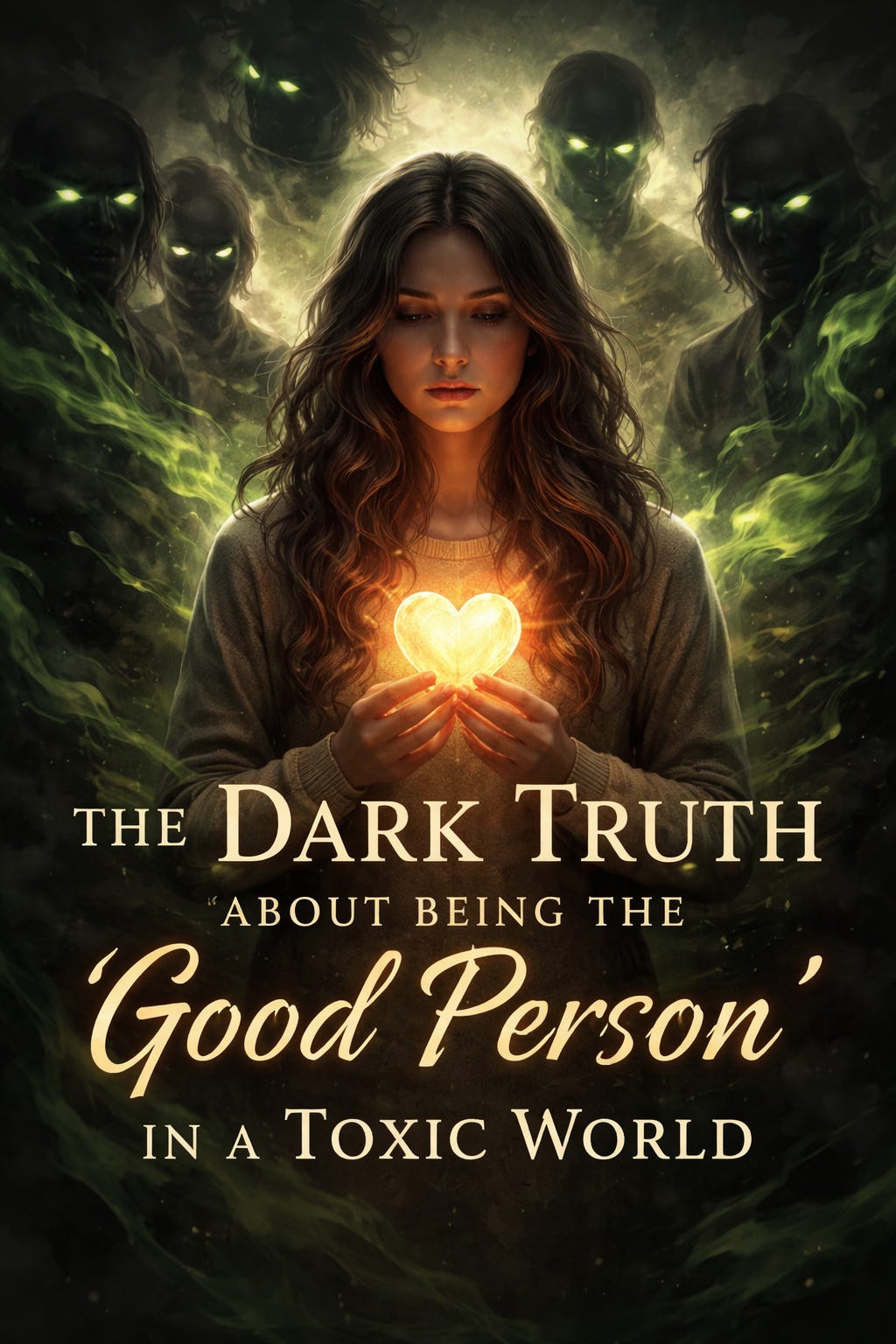
There is a certain kind of person the world quietly relies on.
The one who forgives too quickly.
The one who listens when everyone else is tired.
The one who tries to understand instead of retaliate.
The one people describe with a simple sentence:
“They’re such a good person.”
At first glance, it sounds like the highest compliment a human being can receive.
But spiritual psychology reveals something uncomfortable beneath that label.
Because in a toxic world, being the “good person” often comes with a hidden cost that few people talk about.
And sometimes that cost is your own emotional survival.
The Good Person Is Often the Emotional Shock Absorber
In many families, friendships, and relationships, there is an unspoken role that one person ends up carrying.
They become the emotional stabilizer.
When someone is angry, they calm things down.
When someone is hurtful, they excuse the behavior.
When conflict appears, they smooth everything over.
They absorb tension so others do not have to face it.
Over time, something subtle begins to happen.
The good person stops being treated like a human being with limits.
They become the system that holds everyone else together.
People start assuming:
“You’ll understand.”
“You’re strong.”
“You’re different.”
But what those words often really mean is something else:
“You will tolerate what others would not.”
And that is where the quiet damage begins.
Toxic Systems Reward the Most Tolerant Person
In healthy environments, kindness is respected.
But in toxic environments, kindness is often exploited.
Not always intentionally.
Not always consciously.
But repeatedly.
The person who forgives easily becomes the person people hurt repeatedly.
The person who listens patiently becomes the one people emotionally unload on without reciprocity.
The person who avoids conflict becomes the one whose boundaries slowly disappear.
And the most painful part is this:
The good person rarely notices when the line is crossed.
Because they are too focused on keeping peace.
Spiritual psychology calls this compassion without boundaries.
And compassion without boundaries is not healing.
It is self-erasure.
Many “Good People” Learned This Role in Childhood
For many people, being the good one did not begin in adulthood.
It began much earlier.
Maybe they grew up in a household filled with tension.
Maybe one parent was unpredictable.
Maybe emotional conflict was overwhelming.
So they adapted.
They became the calm one.
The understanding one.
The responsible one.
They learned something powerful but dangerous:
If they stayed kind enough, patient enough, agreeable enough, life became a little less chaotic.
So they carried this strategy into adulthood.
But the world outside childhood does not always reward that survival strategy.
Sometimes it attracts the exact opposite.
Manipulators.
Emotionally immature partners.
People who take and rarely give.
And suddenly the good person finds themselves asking a painful question:
Why do I keep ending up in relationships where I give everything and still feel invisible?
Being Good Is Not the Same as Being Boundless
Spiritual psychology makes an important distinction.
There is a difference between goodness and limitlessness.
True goodness includes compassion, empathy, and patience.
But it also includes something many people forget:
Self-respect.
Without self-respect, goodness becomes an open door.
Anyone can walk through it.
Anyone can leave emotional damage behind.
Anyone can assume the door will always remain open.
And eventually, the good person becomes exhausted in a way that is difficult to explain.
They feel tired not just physically, but spiritually.
Because they have spent years giving understanding to people who never truly tried to understand them.
The Moment Good People Begin to Change
One day, something shifts.
It might be a betrayal.
A final disappointment.
A quiet moment of clarity.
But suddenly the good person begins to notice patterns they once ignored.
They see how often they were the one apologizing.
How often they were the one compromising.
How often they were the one holding relationships together.
And something inside them whispers a simple but powerful realization:
Being kind should not require disappearing.
This is the beginning of spiritual maturity.
Not when someone becomes colder.
But when they begin to understand the sacred balance between kindness and protection.
The World Does Not Need Fewer Good People
But It Needs Stronger Ones
The answer to a toxic world is not becoming cynical or cruel.
The answer is becoming conscious.
A truly evolved person still chooses kindness.
But they also recognize manipulation.
They recognize emotional immaturity.
They recognize when compassion is being mistaken for weakness.
They no longer give endlessly to people who drain them.
They offer kindness where it is respected.
And distance where it is not.
This is not cruelty.
It is spiritual self-preservation.
A Quiet Truth Many Good People Discover
Eventually, the good person learns something life-changing.
Their purpose was never to tolerate everyone.
Their purpose was to love wisely.
To support people who grow.
To walk away from people who only consume.
To remain kind without becoming invisible.
Because goodness was never meant to destroy the person who carries it.
It was meant to illuminate the world.
But even light needs protection.
Otherwise, it burns itself out trying to warm people who refuse to appreciate the fire.