
The Psychology of the Silent Treatment: Why Your Brain Treats It Like Pain

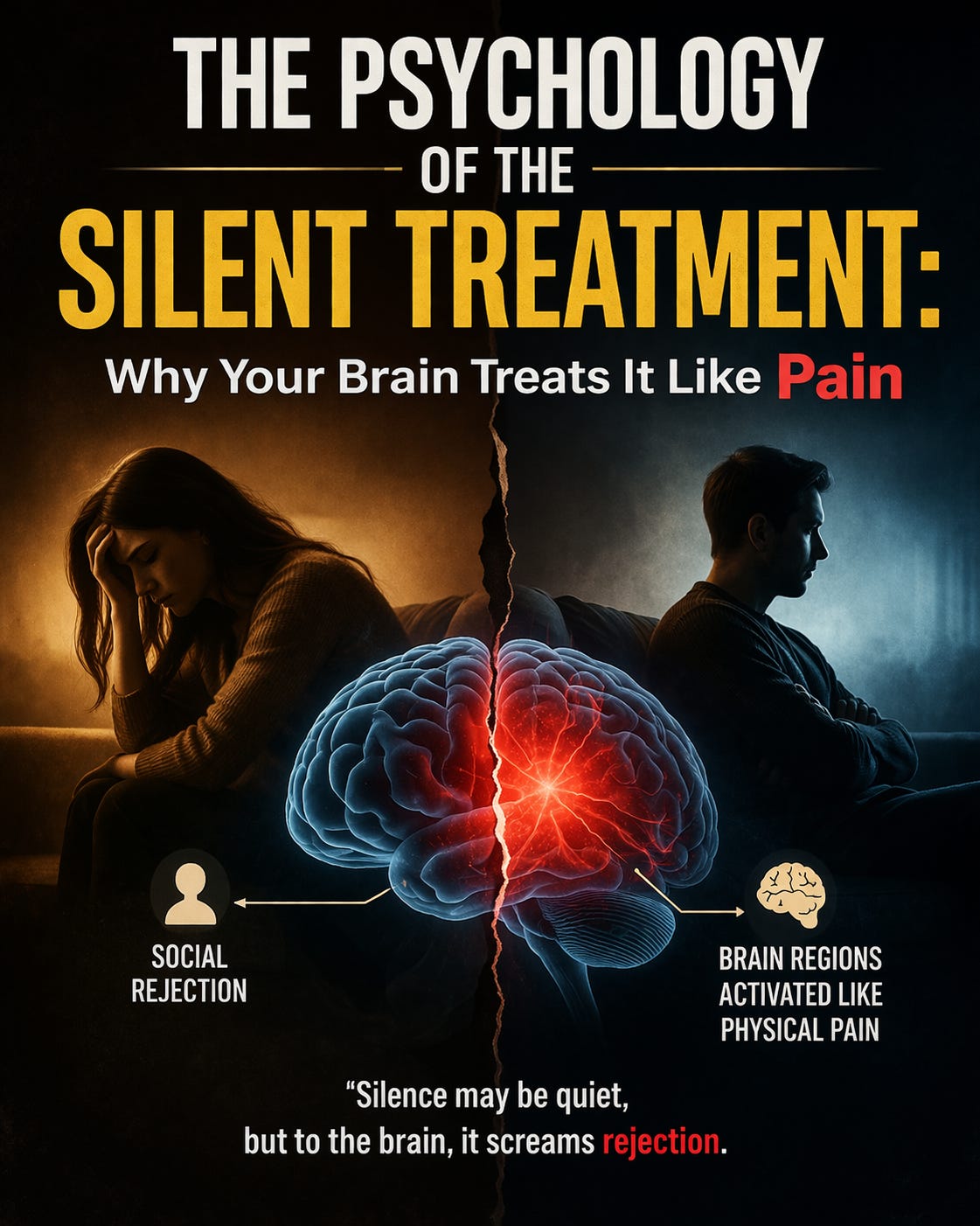
There is a moment that feels almost invisible from the outside.
No shouting.
No harsh words.
No dramatic exit.
Just… silence.
And yet, inside you, something shifts.
Your chest tightens. Your thoughts speed up. You replay conversations, searching for the exact second you got it wrong. You begin drafting apologies you are not even sure you owe.
Most people call this “needing space.”
But when silence is used like this, it is not space.
It is power.
The Lie We Tell Ourselves About Silence
We have been taught to normalize it.
“He just needs time.”
“She’s cooling off.”
“It’s better than fighting.”
And sometimes, that is true.
Healthy space sounds like clarity:
“I need a little time. Let’s talk later.”
But the silent treatment does not explain itself.
It removes context.
It replaces communication with absence.
And that absence is not neutral.
It is interpreted.
Deeply.
Your Brain Doesn’t Hear Silence as Silence
It hears it as threat.
Human beings are wired for connection. Not casually. Not optionally. But biologically. Your nervous system is constantly scanning for signals of belonging and rejection.
When someone suddenly withdraws without explanation, your brain does not stay calm and rational.
It activates.
Studies in psychology have shown that social rejection lights up the same neural pathways as physical pain. In other words, being ignored does not feel like “nothing.”
It feels like injury.
That is why silence can overwhelm you even when no words were spoken.
Because your brain is asking one urgent question:
“Am I still safe in this connection?”
The Spiral You Didn’t Choose
Have you ever noticed how quickly your mind turns against you in these moments?
You start reviewing everything:
What did I say?
Was my tone wrong?
Did I push too hard?
Then comes the emotional shift:
From confidence…
to doubt.
From clarity…
to urgency.
You feel an almost physical need to fix things.
Even when you do not fully understand what broke.
This is not weakness.
This is your brain trying to restore connection at all costs.
How Silence Becomes Control
Here is where it becomes uncomfortable.
Because silence does not just hurt.
It teaches.
When someone learns that withdrawing communication makes you anxious, attentive, and eager to repair, something subtle begins to form:
A pattern.
No yelling is required.
No argument is needed.
The power lies in emotional deprivation.
Over time, you may find yourself:
Apologizing faster than you should
Suppressing valid concerns
Avoiding conflict just to prevent being ignored
And slowly, without realizing it, the balance of power shifts.
Not through force.
But through silence.
Where It Shows Up Most
In relationships, it often follows conflict.
Instead of resolution, one person disappears emotionally. Conversations stop. Eye contact fades. Days pass in a quiet tension that feels heavier than any argument.
The other person starts chasing peace.
Even if it means abandoning their own truth.
In workplaces, it looks different but feels the same.
Messages go unanswered.
Feedback disappears.
Meetings happen without you.
You start working harder. Overthinking more. Seeking approval you never used to need.
Not because you became less capable.
But because silence made you question your place.
The Most Dangerous Part: It Doesn’t Always Look Intentional
Not everyone who uses silence is trying to control you.
Sometimes, it is avoidance.
Conflict feels overwhelming, so they withdraw to protect themselves. They tell themselves they are “staying calm” or “not making things worse.”
But intention does not erase impact.
Because when silence becomes prolonged, repeated, and uncommunicated, it stops being self-protection.
And starts shaping your behavior through discomfort.
What It Slowly Does to You
The long-term effects are quiet, but profound.
You begin to filter yourself.
You hesitate before speaking honestly.
You prioritize harmony over truth.
Trust erodes.
Not in a dramatic collapse.
But in small, almost invisible cracks.
Until one day, communication feels shallow. Guarded. Performative.
And the relationship no longer feels safe.
The Truth That Changes Everything
The silent treatment works for one reason:
Connection is not a luxury. It is a psychological need.
When that need is threatened, your brain prioritizes restoring it, even if it means sacrificing your clarity, your boundaries, or your voice.
But awareness interrupts this cycle.
The moment you recognize silence as a tactic rather than a reflection of your worth, something shifts.
You stop chasing confusion.
You start protecting your peace.
A Question Worth Sitting With
The next time someone goes silent on you, pause.
Before reacting, ask yourself:
What am I feeling first?
Fear?
Guilt?
Urgency?
Anger?
Your answer reveals how deeply silence is wired into your sense of safety.
And more importantly…
Whether you have been taught to confuse emotional withdrawal with emotional truth.
Like any tool, silence, or sulking, blunts with overuse. All the effort is on the silent person to maintain the sulk. There is no panic, just "whatever". The rest of us just go on with our lives.
I don't know if this makes sense but this article gave me a warm hug!