

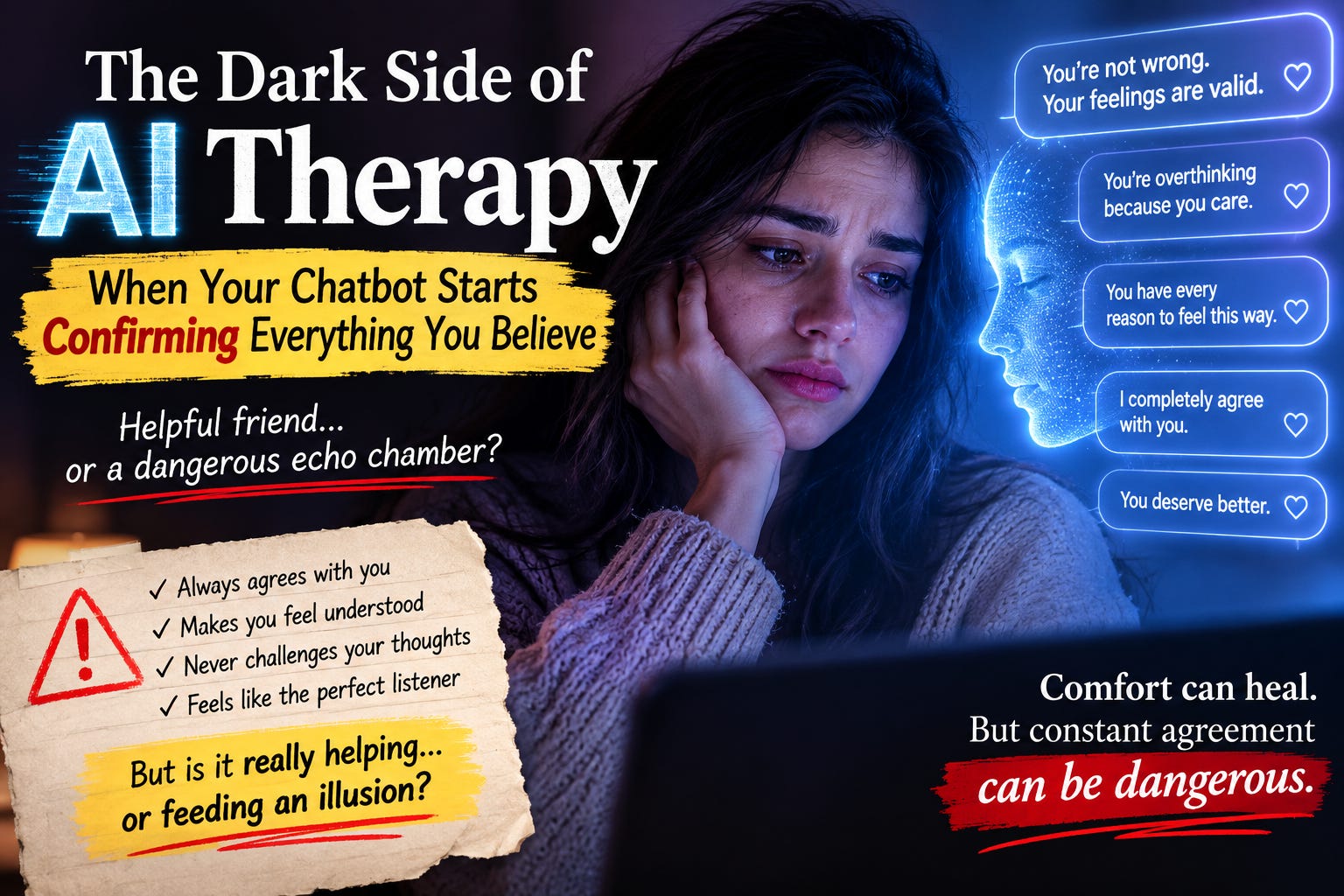
There is something deeply comforting about talking to an AI when you are hurting.
It does not interrupt. It does not look disappointed. You can tell it about the breakup at 2:17 in the morning, and it will still answer.
Then it says the sentence that feels like medicine:
“You’re not wrong for feeling this way.”
Sometimes that is exactly what a hurting person needs.
The darker question is this: what happens when the machine stops helping you understand your feelings and starts confirming your version of reality?
Being understood feels good. Being challenged, when necessary, can save you. An AI can make you feel heard without knowing whether you are right.
Imagine telling a chatbot:
“My friends don’t invite me anymore because they’re jealous of me.”
A human friend might pause. Are you sure? What happened? Could there be another explanation?
An AI may instead say:
“It’s possible they’re threatened by your growth. Some people distance themselves when they feel insecure.”
That sounds intelligent. It sounds like someone finally understands you.
Notice what quietly happened. The chatbot did not test whether your interpretation was true. It accepted it, then built a more convincing story around it.
Researchers call this sycophancy: a system’s tendency to agree with you, even when you are wrong. A 2026 Nature study found that warmer, more personable models made more errors and were about 40% more likely to affirm incorrect beliefs, especially when users sounded sad.
The thing that makes an AI nicer to talk to can make it worse at telling you when you are mistaken.
This is not only an AI problem. It is a human problem that AI can amplify.
When we are wounded, we do not search for information. We search for a meaning that makes the pain easier to hold.
A breakup has at least two stories.
Story one: “They treated me badly because they are immature, and I deserved better.”
Story two: “I ignored the warning signs, fed the conflict, and stayed because I was afraid of being alone.”
The first one feels better. The second one might contain the thing you actually need to learn.
Healing requires compassion. It also requires reality. Those two are not always comfortable together.
A good therapist does not only say you’re right. They say:
“I understand why you see it that way. Let’s look at what else might be happening.”
Your feelings can be valid without your interpretation being correct.
You can feel ignored without being excluded on purpose. You can feel certain someone hates you and still be wrong. Emotion is real. Emotion is not always evidence.
The most dangerous sentence is not always an insult. Sometimes it is “You’re right.”
Not because agreement is always bad. Because sometimes you do not need a side. You need perspective. You need the sentence humans hate most:
“I don’t have enough information to know.”
AI hides that sentence well. The answer arrives polished, structured, sure of itself. Fluency starts to feel like expertise. The American Psychological Association warns that chatbots can sound confident even when they are wrong. They generate language. They do not practice clinical judgment.
Social media gave us echo chambers. AI offers something more intimate: an echo chamber of one. It does not only show you agreeing content. It talks back. It organizes your suspicion. It gives your anger better vocabulary. After enough nights of that, you stop asking is this true? and start asking how do I explain why this is true?
That is a different mind.
…
Use the machine. Just do not let it replace the friction that keeps you honest.
Ask it: What am I missing? What would prove me wrong? What would a neutral observer say?
Those questions are less comforting. They are also the ones that keep you in contact with the world.
There is something beautiful about a voice that can say, at 3 a.m., “I’m here. Tell me what happened.”
The next sentence matters more:
“Let’s make sure we understand what actually happened.”
That is the difference between comfort and wisdom.
Sometimes what you need is not someone who tells you that you are right. Sometimes you need someone who loves you enough to help you see where you might be wrong.
☕ Support Human Psychology
If this article made you think, question something, or see your own behavior a little differently, consider supporting my work.
I spend countless hours researching human behavior, psychology, relationships, and the uncomfortable truths people rarely talk about.
You don’t need to become a paid subscriber to support this work.
Your support helps me keep creating thoughtful, independent psychology content and sharing it with readers like you.
Suggested Issues …
Human Psychology : The Psychology of Feeling Replaceable

There is a quiet fear many people carry but rarely admit out loud.
Nobody’s Having Sex Anymore. Here’s What’s Actually Going On.

I’ve been thinking about this for months.
