

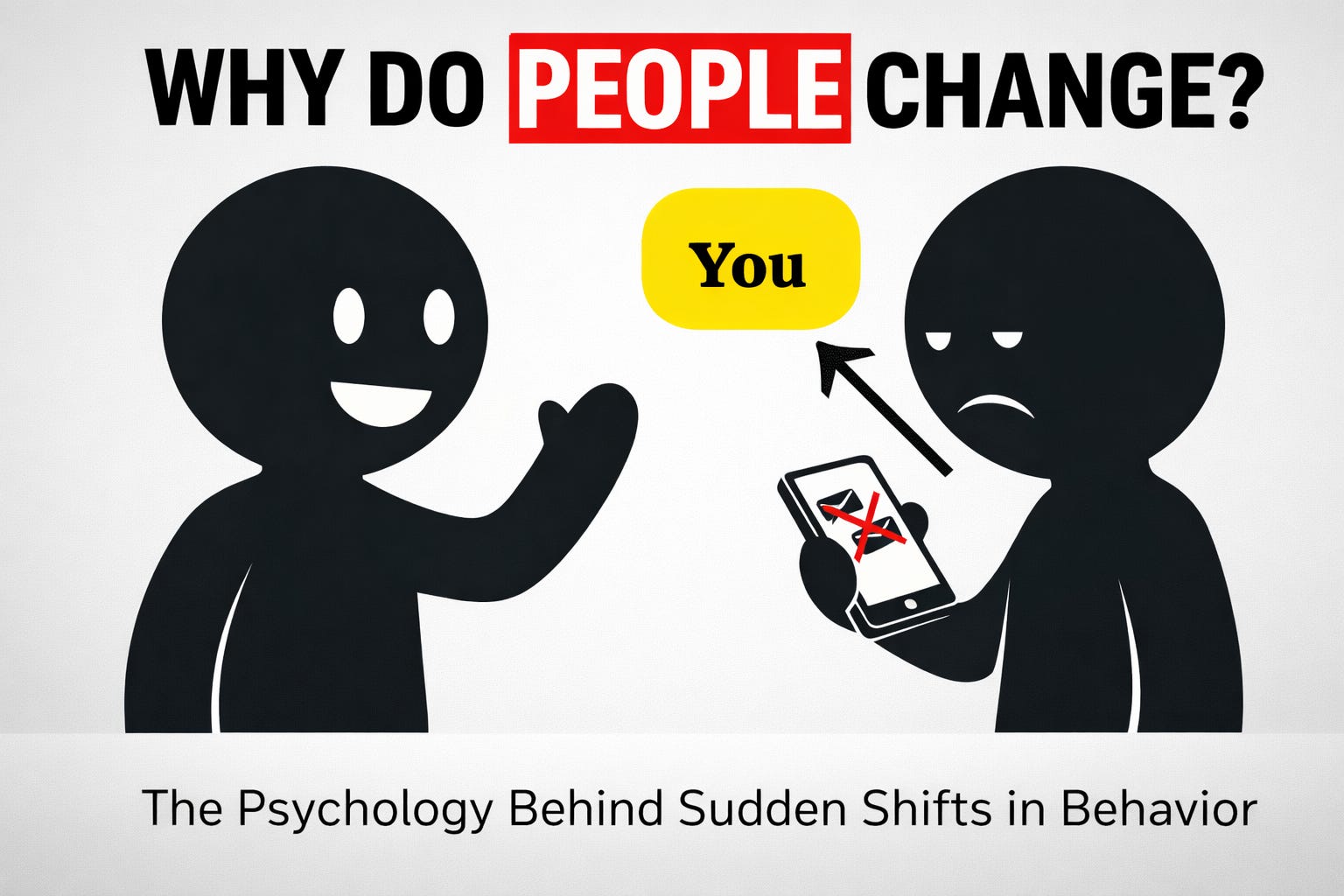
There is a particular kind of pain that comes from watching someone become unfamiliar.
Not the pain of losing them completely.
Not even the pain of an argument.
But something quieter.
Stranger.
The pain of sitting across from someone you once knew deeply and suddenly feeling like you no longer recognize them.
The way they speak changes.
The way they respond changes.
The warmth changes.
The effort changes.
Even silence changes.
And somehow, without anyone announcing it, the relationship begins to feel like an old home that still looks the same from outside but no longer feels lived in.
You start replaying memories.
Old messages.
Conversations.
Moments that once felt certain.
And somewhere inside your mind, a question begins repeating itself like an unanswered prayer:
“What happened to them?”
Maybe you ask it after a friendship quietly fades.
Maybe after someone who once cared deeply begins responding with emotional distance.
Maybe after watching someone slowly become colder, quieter, sharper, or simply less present.
And because human beings are meaning-making creatures, we immediately begin looking for explanations.
Did I do something wrong?
Did they stop caring?
Was I replaced?
Was the person I knew ever real?
But perhaps one of the most uncomfortable truths about human psychology is this:
People rarely change suddenly.
What feels sudden to us is often something that has been unfolding silently for a long time.
And maybe that is exactly why it hurts.
Because while someone else was slowly changing internally, we were still emotionally speaking to the version of them we remembered.
The version we trusted.
The version we quietly believed would stay.
The Lie Hidden Inside the Word “Suddenly”
The human mind loves simple explanations.
They make pain easier to hold.
Someone changed.
Someone left.
Someone stopped caring.
Simple stories help us survive complicated emotions.
But human beings are rarely simple.
And change is almost never immediate.
Think about the ocean.
A wave does not appear from nowhere.
What reaches the shore has been moving long before anyone notices it.
Human emotions work the same way.
Distance rarely starts the day someone becomes quiet.
Coldness rarely begins the moment affection disappears.
Disconnection often begins invisibly.
In overlooked disappointments.
In unresolved resentment.
In exhaustion no one talked about.
In emotional needs quietly unmet.
In personal struggles someone never knew how to explain.
Most transformations happen underground.
Silently.
Without witnesses.
And this is one of the hardest realities to accept:
By the time someone’s behavior changes, their emotions may have already changed long ago.
We notice the visible shift.
But rarely the invisible process that created it.
A person who stops texting first may have spent months feeling emotionally disconnected.
A friend who becomes distant may have been privately overwhelmed long before withdrawing.
Someone who suddenly seems colder may simply be carrying pain they never found language for.
But because suffering is often invisible, we mistake delayed visibility for sudden transformation.
The truth is uncomfortable.
Most people are changing quietly while still pretending everything feels normal.
Including us.
Sometimes People Change Because Life Rearranges Them
One of the strangest things about adulthood is realizing how deeply circumstances shape personality.
As children, we often believe people are fixed.
Kind people stay kind.
Warm people stay warm.
Loyal people stay loyal.
Confident people stay confident.
But life has a way of interrupting who we thought we would always be.
Stress changes people.
Grief changes people.
Responsibility changes people.
Heartbreak changes people.
Success changes people.
Failure changes people.
Exhaustion changes people.
And sometimes survival changes people more than anything else.
There are versions of people that only exist under certain conditions.
The relaxed version.
The loving version.
The hopeful version.
The emotionally available version.
And then there is the version shaped by disappointment, burnout, anxiety, financial pressure, loneliness, betrayal, fear, or emotional exhaustion.
Many people do not become colder because they suddenly stop caring.
Sometimes they become colder because life quietly exhausted the softer version of them.
This does not mean harmful behavior becomes acceptable.
Pain is not permission to hurt others.
But explanation matters.
Because when we understand human behavior, resentment sometimes softens into perspective.
And perspective changes the way we carry heartbreak.
The Version of Someone You Miss May Have Been Temporary
This is difficult to hear.
And even harder to accept.
Sometimes we are not grieving who someone became.
We are grieving the version of them that existed under temporary circumstances.
The person you met during loneliness.
The person who had more emotional space.
The person before stress entered their life.
The person before disappointment hardened them.
Or perhaps the person who simply wanted something different at the time.
Human beings are deeply situational.
Who someone is often depends on what season of life they are surviving.
This is painful because we mistake moments for identities.
We assume consistency where there may only have been timing.
And when someone changes, it feels like betrayal.
But sometimes what hurts is realizing:
You fell in love with a season of someone.
Not necessarily the permanent version.
And that realization can feel devastating.
Because now you are not only grieving the person.
You are grieving the possibility of who they once seemed to be.
Sometimes People Are Not Changing, They Are Revealing
There is another truth people rarely say out loud because it feels too painful.
Sometimes people do not change.
Sometimes comfort simply removes performance.
In the beginning of relationships, friendships, even professional dynamics, people naturally present polished versions of themselves.
We all do.
We become more patient.
More understanding.
More thoughtful.
More emotionally present.
Not because we are fake.
But because we are trying to be accepted.
Trying to be chosen.
Trying to be understood.
Psychologists sometimes call this impression management.
The natural tendency to show the best parts of ourselves early on.
But eventually, effort relaxes.
Emotional comfort arrives.
And masks become heavier to carry.
The patient person becomes impatient.
The affectionate person becomes emotionally distant.
The attentive person becomes distracted.
And suddenly we say:
“You changed.”
But perhaps what we are really saying is:
“I finally met parts of you I had not seen before.”
That truth hurts differently.
Because grieving change feels easier than questioning whether we misunderstood someone entirely.
Still, human beings are complicated.
Most people are not pretending.
They are simply unfinished.
Confused.
Contradictory.
Still learning themselves while asking others to understand them.
And often, failing at both.
Emotional Exhaustion Quietly Changes Personality
One of the most overlooked psychological realities is this:
Exhaustion changes personality.
We tend to imagine personality as stable.
But emotional energy affects almost everything.
How patient someone feels.
How affectionate they behave.
How emotionally available they become.
How much effort they can give.
An overwhelmed nervous system does not show love the same way.
A tired mind does not communicate the same way.
Someone struggling internally may look emotionally unavailable when in reality they are emotionally overwhelmed.
This becomes especially painful in close relationships.
Because when someone withdraws emotionally, we personalize it.
We assume:
“They stopped caring.”
But sometimes the truth sounds more like:
“They no longer had emotional energy left for anything, including themselves.”
And unfortunately, the people closest to us often feel that emotional depletion first.
Not because they matter least.
But because closeness removes performance.
The world gets politeness.
Loved ones sometimes get exhaustion.
It is unfair.
But painfully human.
Pain Changes People in Ways Love Cannot Always Reverse
Pain reshapes personality.
Not always dramatically.
But deeply.
Quietly.
Repeatedly.
A betrayed person may become suspicious.
A rejected person may become emotionally guarded.
Someone abandoned may begin leaving first.
Someone repeatedly disappointed may stop expecting much from anyone.
This is one of psychology’s quieter tragedies.
People adapt to survive.
And survival often changes softness.
Sometimes a warm person becomes colder.
Sometimes trust turns into caution.
Sometimes openness becomes silence.
Not because someone wants to change.
But because staying the same began to feel unsafe.
When people say,
“You are not the same person anymore,”
sometimes what they are really witnessing is emotional scar tissue.
Invisible proof of battles they never fully saw.
The Hardest Truth: Sometimes People Outgrow Each Other
There are painful endings that do not happen because anyone was cruel.
Or dishonest.
Or intentionally harmful.
Sometimes people simply grow in different directions.
One person wants closeness.
The other wants independence.
One person becomes emotionally deeper.
The other becomes emotionally avoidant.
One evolves through healing.
The other evolves through survival.
And eventually, two people who once understood each other begin speaking different emotional languages.
No betrayal.
No explosion.
Just distance.
Slow.
Quiet.
Almost invisible.
Until one day, the relationship feels unfamiliar.
And perhaps this is one of adulthood’s saddest realizations:
Love does not always guarantee alignment.
History does not guarantee permanence.
And caring deeply does not always mean people will continue growing in the same direction.
Sometimes people drift not because love disappeared.
But because compatibility quietly changed.
Maybe the Real Grief Is Losing Certainty
What hurts most when people change is not always the change itself.
It is the uncertainty.
Because change forces us to question memory.
Question trust.
Question meaning.
You begin wondering:
Was any of it real?
Did they ever care?
Did I imagine everything?
But maybe this is the wrong question.
Maybe someone can care deeply and still change.
Maybe something can be real and still end.
Maybe love can exist and still become incompatible.
Humans struggle with this because we think permanence validates meaning.
If something lasted, it mattered.
If something ended, maybe it was fake.
But life rarely works like that.
Some people are chapters.
Not lifetimes.
Some people arrive to shape us.
Not stay forever.
And some versions of people are simply temporary.
Beautiful.
Meaningful.
Real.
But temporary.
This made me tear up. As someone going through a really hard heartbreak, this really made me challenge my perspectives and the narrative I made about the outcome of my situation. Though it does not erase the lived realities and experiences we had with that person, it is worth considering that himan beings are not made to be binary. We are complex species that is shaped by our environment, choices, experiences and thoughts. This concept, though fundamentally true, is still very hard to accept for most of us. But thank you for this eye opening article.
This was a beautiful perspective on human relationships and emotional development.👌🏾✌🏾